

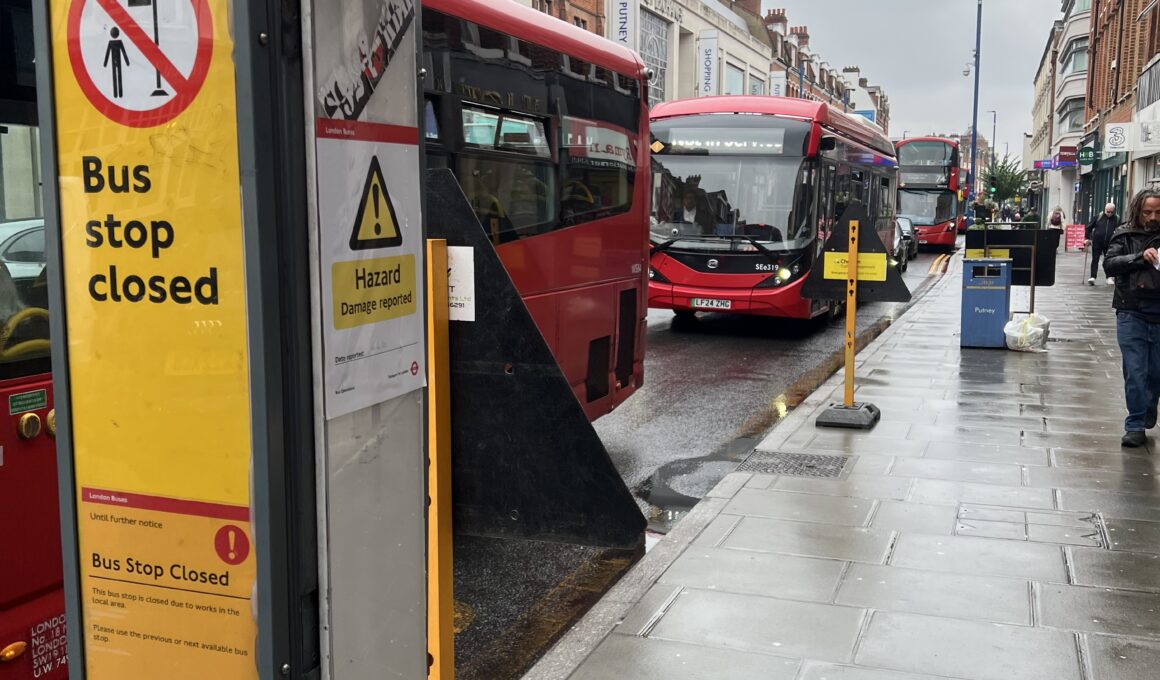
Every Putney resident knows the buses aren’t running properly. They arrive late, clump together, disappear from apps, or worse — dump passengers early and force them to walk. And we all know why: Putney High Street is a traffic nightmare.
But what most passengers don’t realise is that the system designed to detect when bus services fail has stopped flagging the problem — and started normalising it instead.
The stats say it’s fine. Reality says otherwise
A few weeks ago, we revealed the strange case of the 85 bus — possibly the most complained-about service in Putney — scoring as the best-performing route in Transport for London’s (TfL) quarterly reliability data.
That bus frequently terminates early at Putney Heath, leaving passengers to walk the rest of the way. But thanks to a TfL metric known as Excess Waiting Time (EWT), the 85 gets a gold star. That’s because when buses don’t complete their full route, they often don’t count in the stats at all. Operators are rewarded if they keep EWT below one minute. And if it looks like they might miss that target? They cut the route short.
That’s the loophole. If you don’t run the whole service, you don’t risk being penalised. Instead, you earn a bonus.
The end result? The more unreliable the route becomes, the more likely it is to look good on paper — as long as it doesn’t reach the timing points where TfL checks performance.
The Ghost Bus: 265 and the route that can’t be fudged
There is, however, one bus that couldn’t be saved by that trick: the 265.
Running from Putney Bridge Tube Station to Tolworth, the 265 has to go across Putney High Street, right down Lower Richmond Road, and then through Roehampton, Kingston Vale, and out towards New Malden and Tolworth. It’s a long, winding route, much of it on the A3 — and there’s no easy place to curtail it without being noticed.
That’s why last year, locals began calling it “the ghost bus.” Because rather than run a full schedule and get hit with fines for being hopelessly delayed, the operator appeared to simply not run it at all at peak traffic times – which also happen to be when most people wanted to use it. Buses were dropped. Frequency collapsed. The stats got better but complaints piled up.
Eventually, the pressure grew too loud. Local councillors and our MP were contacted. TfL got involved. And the buses were reinstated.
But now that the 265 is running again, the numbers tell the real story: it has the worst Excess Waiting Time score in Putney — 2.1. That’s more than double TfL’s target. A red flag of severe reliability problems.
The numbers don’t lie – unless they’re being massaged
Here’s how Putney’s key bus routes are performing, based on the most recent QSI (Quality of Service Indicator) data:
| Route | Route | EWT Score | Status |
| 85 | Kingston — Putney Bridge | 0.96 | “Top performer” on paper but curtailed constantly |
| 170 | Roehampton — Victoria | 1.3 | Regular curtailments at Putney Heath |
| 430 | Roehampton — South Kensington | 1.4 | Struggles along High Street corridor |
| 493 | Richmond — Tooting | 1.5 | Routinely delayed at traffic pinch points |
| 14 | Putney Heath — Russell Square | 1.6 | Inconsistent and under pressure |
| 93 | North Cheam — Putney Bridge | 1.8 | Misses target consistently |
| 265 | Putney Bridge — Tolworth | 2.1 | Worst performer in Putney |
Every single route – except the magic 85 – is missing TfL’s target of 1.0. Even those using shortcuts and curtailments are just scraping through. And the 265, which has no place to hide, tells the truth: Putney’s bus service is broken.
Everyone wins – except the passengers
So why isn’t more being done?
Because everyone in the system has an incentive to pretend things are fine:
- Bus operators avoid fines and secure bonuses by fudging numbers or dropping buses.
- TfL knows Putney traffic makes the targets impossible, but it doesn’t have the budget to fix the root problem — congestion, outdated timetables, and the closure of Hammersmith Bridge.
- The council, faced with rising complaints, quietly blames TfL, while failing to fix the pinch points it controls.
The only people left out? The passengers. The people waiting at stops. The ones stuck waiting for ghost buses or dumped halfway home.
Want real change? Here’s your chance to push for it
There is, of course, an obvious solution: TfL could update the timetables to reflect reality.
But that’s complex. It involves new modelling, route changes, consultations, political risk, and resources. It’s far easier to quietly bend the system than fix it.
So what is the solution? A good place to start is open dialogue. Which makes it all the more valuable that the Putney Society is hosting a public meeting on the issue of buses in a few weeks to push for answers to already-asked questions.
The event will take place on Monday 23 June at 7.30pm at the Community Church on Werter Road, opposite Sainsbury’s. Guest speakers from TfL, Putney Bus Garage, and Wandsworth Council are expected to attend.
It’s a chance for residents to share their frustrations, ask questions, and hear what (if anything) is being done to fix a system that is clearly not working.
No need to book. Just turn up.
Your journey matters and your voice might just get things moving.
This story originally incorrectly stated that the 493 goes via East Putney – in fact it runs along the East Putney ward boundary.

This has still not been resolved. I go to university of Kingston and one of our campuses is in Roehampton. When leaving Putney station for the past 2 weeks I had had to wait for over an hour of the bus to come, even though on thee Bus times it will say that the bus is only 3 minutes away. Me and a few students would have to sometimes take a cab and that is not efficient as it gets really expensive during peak hours. We have also had to walk to the nearest 265, which even then the bus did not come foe along while.