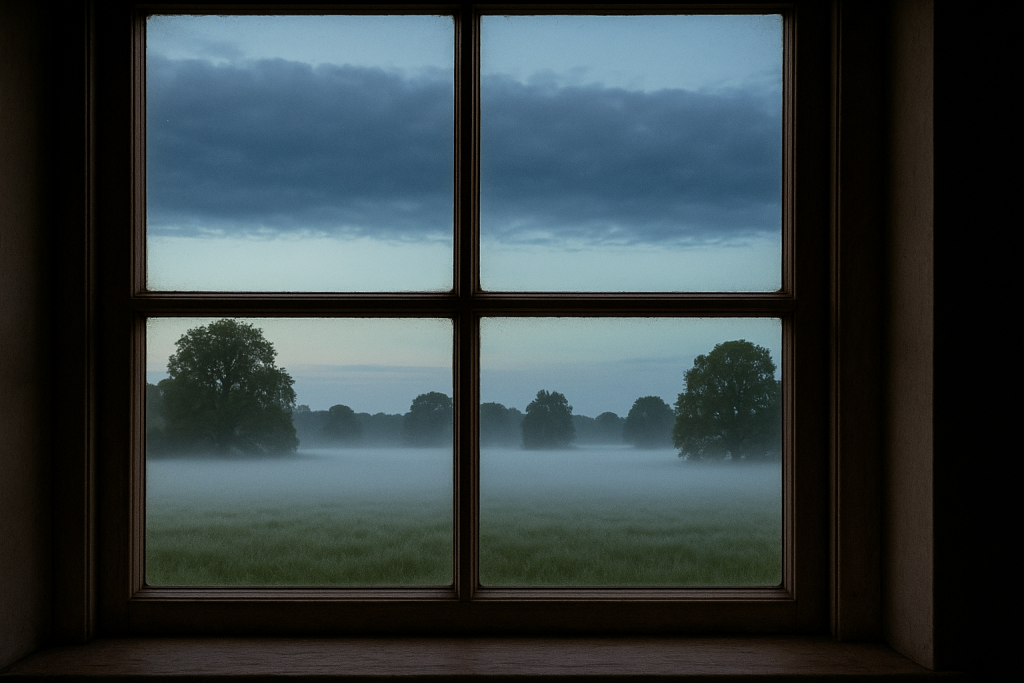
On a beautiful autumn day, Jilly Cooper once observed from her Putney window how “an eiderdown of thick mist lay just above the grass, echoed by a thick band of dark hyacinth blue cloud against a sky of very pale Cambridge blue.”
It was the sort of sentence that could only have been written by someone who walked the same patch of ground every single day, watching the seasons transform, documenting the precise shade of morning mist. For a decade – from 1972 to 1982 – Dame Jilly Cooper, who died on October 5, 2025, at age 88, called Putney Common her daily classroom, her social laboratory, and ultimately, the training ground for a literary career that would revolutionise British popular fiction.
While Cooper became famous for her raunchy Rutshire Chronicles, those sweeping bonkbusters set in the Cotswolds countryside, the truth is that Putney got there first. Those ten years at the edge of the Common shaped everything that followed. Putney taught her to see.
“I loved London, but I used to cry because I missed the countryside”
Cooper arrived in Putney in 1972 with her husband Leo (a military history publisher), their four-year-old adopted son Felix, and two-year-old Emily. The family had struggled financially, but by the time they moved to their home facing Barnes Common, Cooper’s career was gaining real momentum.
Her breakthrough had come in 1968 when Sunday Times Magazine editor Godfrey Smith, entertained by her “bawdy tales of life as a hard-drinking, sexually liberated housewife,” commissioned her to write about her experiences. The resulting column about marriage, sex, and housework began in 1969 and ran throughout her entire Putney residence until 1982. It was frank, witty, revolutionary for its time.
But despite her growing success and genuine love for London, Cooper harboured a deep yearning. In a 2002 interview, she reflected: “I loved London, but I used to cry because I missed the countryside. We did the usual married run: Earl’s Court; Fulham; Putney; Move To The Country.”
Putney represented a compromise – a patch of nature in the middle of the city for a woman who longed for rural life. But it was the perfect compromise. The Common gave her enough nature to satisfy her soul while keeping her close enough to Fleet Street editors and London’s literary world to build her career.
The daily walk: where observation became art
Every morning and evening, Cooper walked the Common. These weren’t peaceful, meditative strolls: the walks were chaotic, social affairs where she encountered what she called “friends, acquaintances, enemies and detractors on a daily basis.”
But they were also her research laboratory.
The dog-walking community of Putney Common was a microcosm of British society; all the class hierarchies, romantic intrigues, and petty jealousies playing out in public every day. Cooper absorbed it all, pencil and notebook in hand, filling diary after diary.
In an interview years later, she explained the diaries’ original purpose: “When I was older and living in Putney, I kept a diary describing the changing seasons. It was meant to be research for the great showjumping novel I wanted to write, which ended up being Riders.”
This revelation is crucial to understanding Putney’s role in Cooper’s creative life. The diaries weren’t idle journaling, they were deliberate preparation for “Riders,” the 1985 blockbuster that would launch her into literary superstardom. Putney Common became her writing school. Every day, she practiced describing light, weather, landscape. She learned to notice everything, and to find the precise words to capture what she noticed.
And while learning to describe nature, she was also studying people. The social dynamics on the Common – who walked with whom, who cut whom dead, which marriages were crumbling – gave her an education in human behaviour that no MFA program could provide. These were the skills that would make “Riders” such a phenomenon: her ability to juggle enormous ensemble casts, to reveal character through sharp social observation, to capture the absurdities of class-obsessed British society.
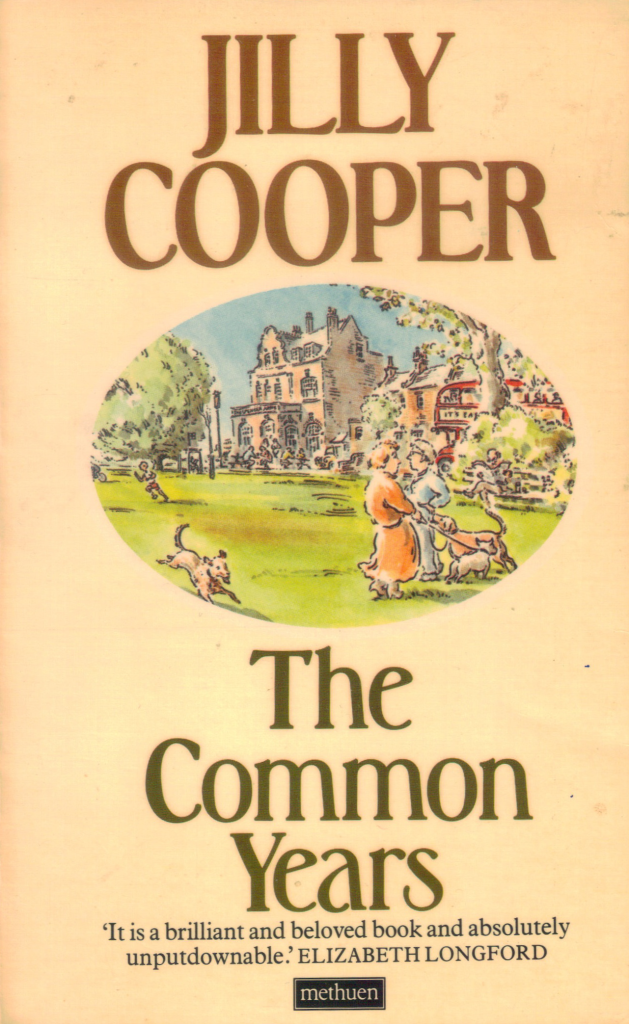
The Common Years: her favorite book
Cooper published “The Common Years” in July 1984, two years after leaving Putney for the Cotswolds. It was “a distillation of those diaries: an affectionate and enthralling portrait, warts and all, of everyday life on Putney Common.”
The book is extraordinary and quite unlike anything else Cooper wrote. While her bonkbusters are famous for their raunchy sex scenes and madcap plots, “The Common Years” is contemplative, lyrical, deeply personal. One reviewer called it “a love letter to the natural world” and compared it to Laurie Lee’s “Cider with Rosie.”
But the book wasn’t sentimentalized. Cooper was honest about her failures, neighborhood conflicts, and financial struggles. The Daily Mail’s Sheridan Morley captured its tone perfectly: “Miss Cooper’s life is a curiously endearing mixture of Joyce Grenfell and August Strindberg—endlessly gracious neighbourly occasions undercut and made bearable by a home life of wonderfully chaotic neurosis and catastrophes.”
Critical reception was glowing. Elizabeth Longford called it “brilliant and beloved…absolutely unputdownable.” But perhaps the most telling review came from Cooper herself. Years later, she said: “I think The Common Years is my favourite.”
Not “Riders,” which sold millions and changed popular fiction forever. Not “Rivals” or “Polo” or any of the blockbusters. Her favorite was the one about walking on Putney Common, watching seasons change, documenting neighborhood dramas.
Writing Putney: building a career
Throughout her Putney decade, Cooper wrote her Sunday Times column from her home, drawing on the life she observed all around her. That column became her first book, “How to Stay Married” (1969), followed by several others. In 1979, while still in Putney, she published “Class: A View from Middle England” – her influential dissection of the British class system that demonstrated the razor-sharp social observation she’d been practicing on the Common.
She also wrote her early romance novel series during the Putney years: Emily (1975), Bella (1976), Harriet (1976), Octavia (1977), Prudence (1978), and Imogen (1978). By 1978, these novels had sold 340,000 copies, making her a successful commercial novelist before she’d even begun the Rutshire Chronicles.
But more importantly, she was thinking about horses.
The Riders revelation: Putney’s greatest gift
Here’s the heartbreaking backstory: Cooper had actually written “Riders” once before, around 1970. Then she left it on a London bus. Despite appeals, it was never recovered. It took over a decade for her to start again.
She started again in Putney.
Throughout the 1970s, while walking the Common and filling her diaries, Cooper was rebuilding “Riders” in her mind. The diaries that documented Putney life were explicitly “meant to be research for the great showjumping novel.”
When “Riders” finally appeared in 1985, it was nearly 1,000 pages of glorious excess. It introduced Rupert Campbell-Black, the impossibly handsome showjumper who would become Cooper’s most famous creation. It was frank about sex, bitchy about class, and utterly compulsive.
It revolutionized popular fiction. The BBC included it on their list of 100 important English language novels. It launched the “bonkbuster” genre and made Cooper a household name, selling millions upon millions of copies.
But “Riders” was gestated in Putney. The observational skills, the ability to juggle multiple characters and plotlines, the eye for revealing social detail – all of it came from those Common years. Every morning walk observing human behaviour, every diary entry, every careful notation was preparation.
Putney gave her “Riders.” And “Riders” gave her everything that followed: the ten subsequent Rutshire Chronicles (including “Rivals,” recently adapted into a smash-hit Disney+ series), 11 million books sold in the UK alone, Dame Commander honours, and a place in British literary history.
Return to Putney: full circle
In September 2024, Cooper returned to her former Putney home for a BBC documentary, “Jilly Cooper: In My Own Words.” Forty-two years after leaving, she stood again at the edge of Putney Common. One can only imagine what memories flooded back.
The documentary aired this time last year. On October 5 this year, Cooper suffered a fall at her Gloucestershire home and died. She was 88.
The tributes poured in.
“A literary force whose wit, warmth and wisdom shaped British culture for over half a century.”
Prime Minister Keir Starmer
But the most moving tribute came from Queen Camilla, Cooper’s close friend: “Very few writers get to be a legend in their own lifetime but Jilly was one…May her hereafter be filled with impossibly handsome men and devoted dogs.”
Cooper lived to see “Rivals” adapted into a hugely successful Disney+ series in 2024. She served as executive producer and watched with sparkling eyes as her fictional Rutshire was brought to life. The show earned 95% on Rotten Tomatoes and has been renewed for a second season.
The common thread
The arc from Putney Common dog walker to Dame Commander of the British Empire is remarkable. But perhaps it’s not so surprising. Because everything Cooper became – the astute social observer, the lyrical nature writer, the fearless chronicler of sex and class – was formed during those ten years walking the same patch of ground twice a day.
Putney Common taught her patience, discipline, and attention to people. When she left Putney in 1982, she took those skills to Gloucestershire and created an empire. But she never forgot that Putney Common was where she learned to see.
“The Common Years,” she said, was her favorite book. Perhaps that tells us everything we need to know. In a career spanning five decades and selling tens of millions of books, Dame Jilly Cooper’s favorite work was her love letter to a patch of London common where she walked, watched seasons change, and learned to become the writer she was meant to be.
Putney made Jilly Cooper. And in “The Common Years,” Jilly Cooper made Putney immortal.