This evening, black-tie guests will gather at the Grosvenor House Hotel for the White Knights Ball, one of the oldest charity balls in London. The event raises funds for work that is genuinely moving: pilgrimages taking seriously ill people to Lourdes, soup runs feeding the homeless at Lincoln’s Inn Fields, and – perhaps most remarkably – the Holy Family Hospital in Bethlehem, the only maternity hospital in the region with a level-three neonatal unit, delivering over 4,700 babies a year with 174 Palestinian staff, Christian and Muslim alike.
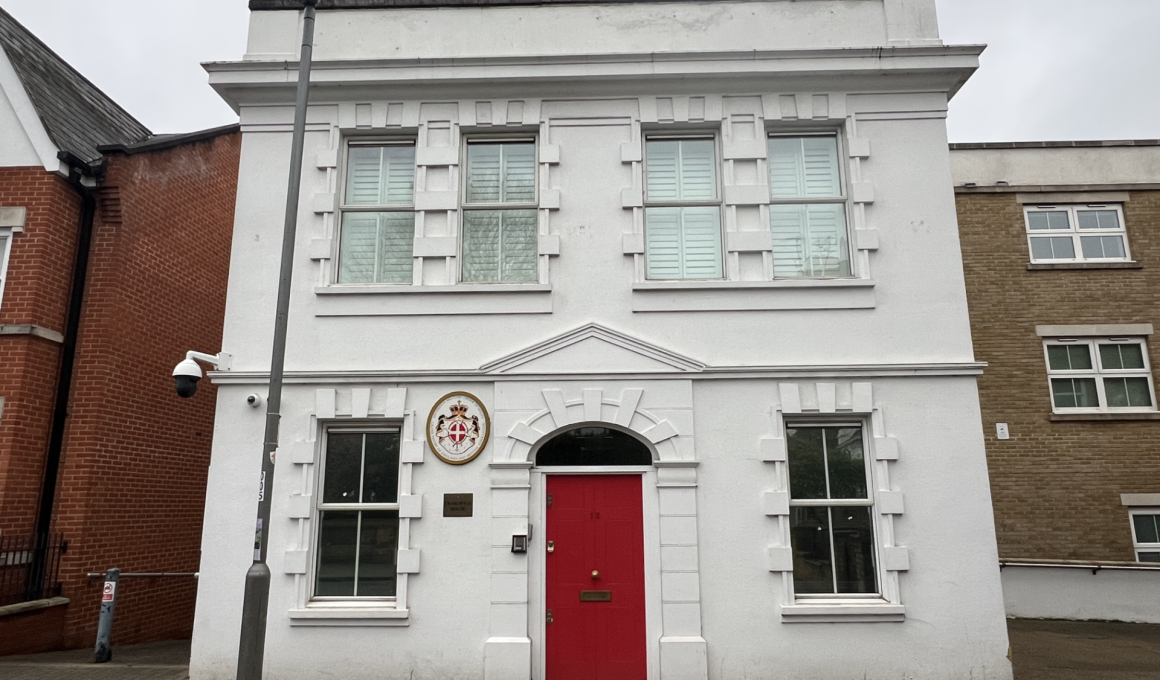
The ball is organised by the British Association of the Sovereign Military Order of Malta, which operates from an elegant Edwardian house at the quiet end of Deodar Road in Putney. The building has a distinctive red front door and a coat of arms featuring an eight-pointed white cross – the symbol of the Knights of Malta.
But behind the champagne and the undeniably good works lies a remarkable story: the British branch of a crusader-era military order, run by some of England’s oldest Catholic families, which has found itself at the centre of a bitter constitutional battle with the Vatican – a battle that pits papal authority against English charity law, and raises questions about who really controls the Order’s considerable assets.
When is a country not a country?
The Sovereign Military Order of Malta is, technically speaking, a country. It has diplomatic relations with 114 nations, observer status at the United Nations, its own passports and currency. Yet it possesses no territory beyond two buildings in Rome granted by Italy under an extraterritorial agreement similar to an embassy.
That sovereignty isn’t merely ceremonial. When Cyclone Nargis devastated Myanmar in 2008, the Order’s relief agency was one of the very few international organisations able to start immediate operations – precisely because its neutral, apolitical status gave it access where other foreign relief organisations were denied. The Order can negotiate entry into conflict zones without alignment to any national interest, obtain customs privileges for medical equipment, and offer stronger protection for humanitarian staff in dangerous regions. It can even act as a mediator between warring states.
But sovereignty also confers something else: status. Membership is by invitation only. Until the 1990s, the highest classes required proof of noble lineage. Members receive titles – Knight, Dame – with ranks ascending through Knight Grand Cross to Bailiff Grand Cross. The Grand Master holds the style “Most Eminent Highness.” Senior figures receive diplomatic passports: crimson-red documents with gold lettering, of which only 500 exist worldwide – the rarest passport on earth.
This is, in other words, an exclusive club with real power, ancient privileges, and access to the corridors of global influence. Small wonder that when the Pope moved to curtail the Order’s independence, resistance was fierce.
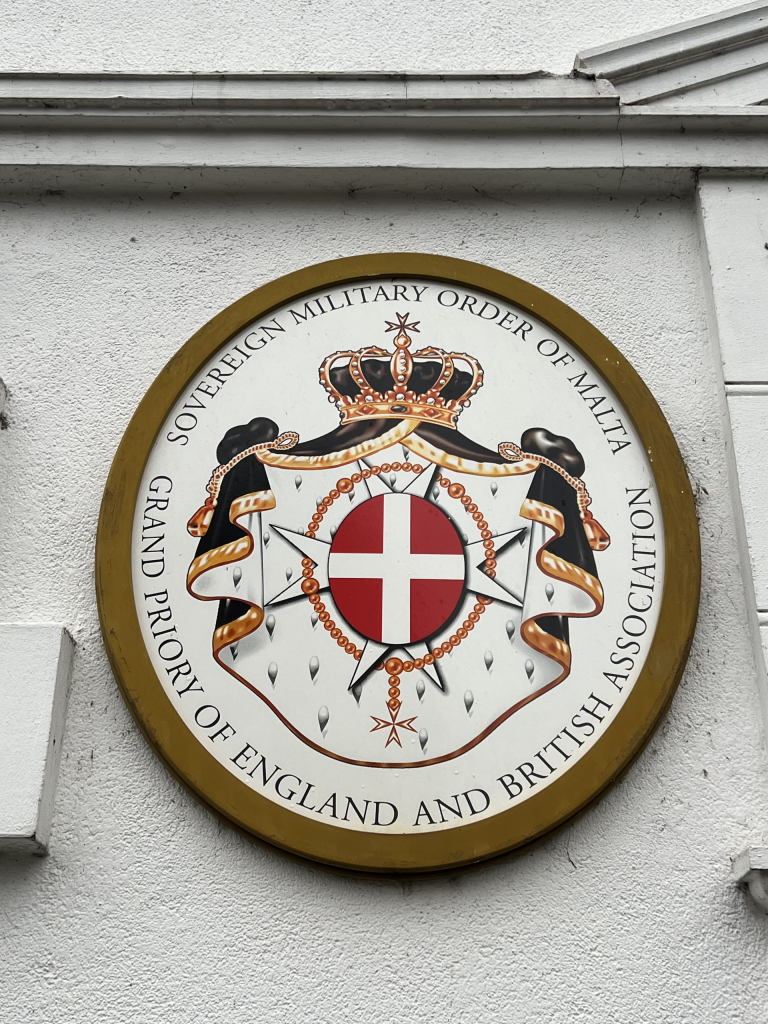
Based in Putney
The Putney headquarters coordinates the Order’s charitable work across England and Wales with just two employees and 600 volunteers – a remarkable ratio.
The work is genuinely impressive. Beyond the Bethlehem hospital, the British Association funds Lebanon operations serving 50,000 people annually through nine health centres, having assisted 175,000 Syrian refugees since 2011. Closer to home, volunteers run soup kitchens on Monday nights from St James’s Spanish Place in central London, collecting leftover food from Eat shops and distributing it at Lincoln’s Inn Fields to between 30 and 80 people depending on the weather. There are tea parties for isolated elderly people, care home support, and the annual Lourdes pilgrimage – a full medical operation taking seriously ill “guests” to the shrine with doctors, nurses, and volunteers.
The Order traces its origins to 1048, when merchants from the Italian city of Amalfi established a hospital in Jerusalem to care for Christian pilgrims. After the First Crusade captured the city in 1099, the hospitallers became a military order, defending pilgrims and caring for the sick. They’ve been doing both ever since – from Rhodes, from Malta (until Napoleon expelled them in 1798), and now from Rome.
The British Association’s leadership reads like a roll call of Catholic aristocratic families who maintained their faith through centuries of persecution.
Lady Celestria Hales, the current President, is the daughter of the 5th Earl of Gainsborough. Her father held the same position in the late 1960s and early 70s – the family has been involved with the Order for over half a century. She succeeded Richard Fitzalan-Howard, connected to the Duke of Norfolk, the premier Catholic peer in England.
These aren’t random connections. The Order’s British membership has traditionally drawn from “recusant” families – those who refused to attend Church of England services after the Reformation and paid the price through fines, imprisonment and execution. Three Knights of Malta were martyred under Henry VIII.
Fra’ Matthew Festing, the British Grand Master who led the entire Order until 2017, was himself descended from one of those martyrs – Blessed Adrian Fortescue – through his mother’s Riddell family. The Order’s governance has passed through these interconnected Catholic dynasties for generations.
Then the Pope intervened
The trouble began in 2016 with condoms.
Albrecht von Boeselager, the Order’s Grand Hospitaller (essentially its head of charitable operations), was suspended by Grand Master Festing after it emerged that the Order’s relief agency had distributed condoms in Myanmar as part of an HIV prevention programme. Conservative members, backed by Cardinal Raymond Burke, wanted Boeselager gone.
Pope Francis saw it differently. He ordered Boeselager reinstated, demanded Festing’s resignation, and launched what would become a sweeping reform of the entire Order.
By September 2022, Francis had promulgated an entirely new constitution. He dissolved the governing council, appointed a provisional government, abolished the requirement for noble birth among senior knights, and limited Grand Masters to ten-year terms rather than life. Most significantly, the new constitution defined the Order as “subject to the Holy See” – language critics said effectively ended its nine-century claim to sovereignty.
If the Order is merely a Vatican department rather than an independent sovereign entity, it loses the neutral status that allows it to operate in conflict zones, or anywhere that association with a particular state might prove problematic. The practical consequences for humanitarian work could be severe.
The Pope’s message to resistant members was blunt: “Conflicts and opposition harm your mission. Lust for power and other worldly attachments create distance from Christ.”
The British problem
In October 2022, Richard Fitzalan-Howard wrote to all British members with a stark warning: the Pope’s reforms were “illegal under UK charity law.”
His argument: the British Association is a standalone English charity, registered with the Charity Commission, governed by trustees with personal legal liability. The Pope can reform the Order’s religious structure, but he cannot unilaterally transfer control from UK charity trustees to Rome, and any attempt to redirect British charitable funds would attract the Commission’s attention.
The assets at stake aren’t trivial. The British Association holds investments worth £11.3 million and total reserves of £12.2 million – equivalent to 101 months of spending. These funds were built up over decades from legacies given for specific charitable purposes. English charity law exists precisely to prevent such restricted funds being redirected by external authorities – even papal ones.
Interestingly, the corporate restructuring happened right in the middle of the Vatican crisis. Between 2015 and 2017, the British Association absorbed several predecessor charities – The BASMOM Trust (dating from 1959), The BASMOM Foundation, and the original unincorporated association – consolidating everything into a single incorporated charitable company governed by English law.
The finances tell their own story. Donations have collapsed from £720,000 in 2020 to just £271,000 in 2024 – a 62% decline. Zero legacies were received in 2024, compared to £545,000 in 2021. The charity now spends more on fundraising (£371,000) than it receives in donations. It is, essentially, living off its investment portfolio.
Whether the falling donations reflect the Vatican conflict, changing demographics among Catholic philanthropists, or broader trends in charitable giving is unclear. But an organisation running annual deficits while sitting on eight years of reserves is one that appears to be managing decline rather than growth.
Pope Francis died on Easter Monday 2025, following a prolonged illness. His successor, Pope Leo XIV – an American, the first from the Americas – has continued the reform agenda, albeit with softer language.
Meeting the Order’s Grand Master in June 2025, Leo stressed that renewal “cannot be simply institutional, normative: it must first of all be interior, spiritual.” In plain English: stop complaining about the rule changes and accept them.
But even Boeselager – the man Francis saved in 2017 – has gone public with criticism. In a letter to members, he wrote that he “cannot imagine” the new constitution will help the Order’s work, and that he has “received many messages from members who are questioning their continued membership.”
The risk, according to Catholic News Agency reporting, is that national associations may “decide to disengage from the order, maintaining their autonomy to run their charitable work while avoiding being treated in the same way as religious organisations.”
Craigmyle House
The building itself arrived in the Order’s hands in November 2015, when they moved from 58 Grove End Road in St John’s Wood. It was initially called “The White House” before being renamed Craigmyle House the following year in honour of Thomas Shaw, 3rd Baron Craigmyle, a former President of the British Association described in his Times obituary as “one of Britain’s most philanthropic Roman Catholic laymen” – a convert with “deep piety and astonishing personal generosity.”
Deodar Road, named after the Himalayan cedar, curves gently through what was once part of the Roehampton estate. The houses here sell for several million pounds. The building serves as both headquarters and meeting space for an organisation that has maintained a presence in London since 1875.
The next time you walk past, remember: behind that red door sits the British outpost of a sovereign entity older than most European nation states, governed by descendants of families who faced execution rather than abandon their faith, currently navigating a constitutional crisis that pits medieval claims of papal authority against modern English charity law.
The Winter Ball is sold out. But the battle with Rome continues.
This is the second in an occasional series exploring the unexpected organisations operating quietly in Putney. Read the first: Brazil’s admirals have been quietly shopping for warships in Putney since 1971.
Correction: This story initially said that tonight was the “Winter Ball” being hosted at the the Hurlingham Club by the British Association of the Sovereign Military Order of Malta, it is in fact The White Knights Ball.