“It looked like a bomb had gone off,” Frances Bird remembers. “There was one big massive bang, black smoke everywhere, and then fire tearing through the houses.”
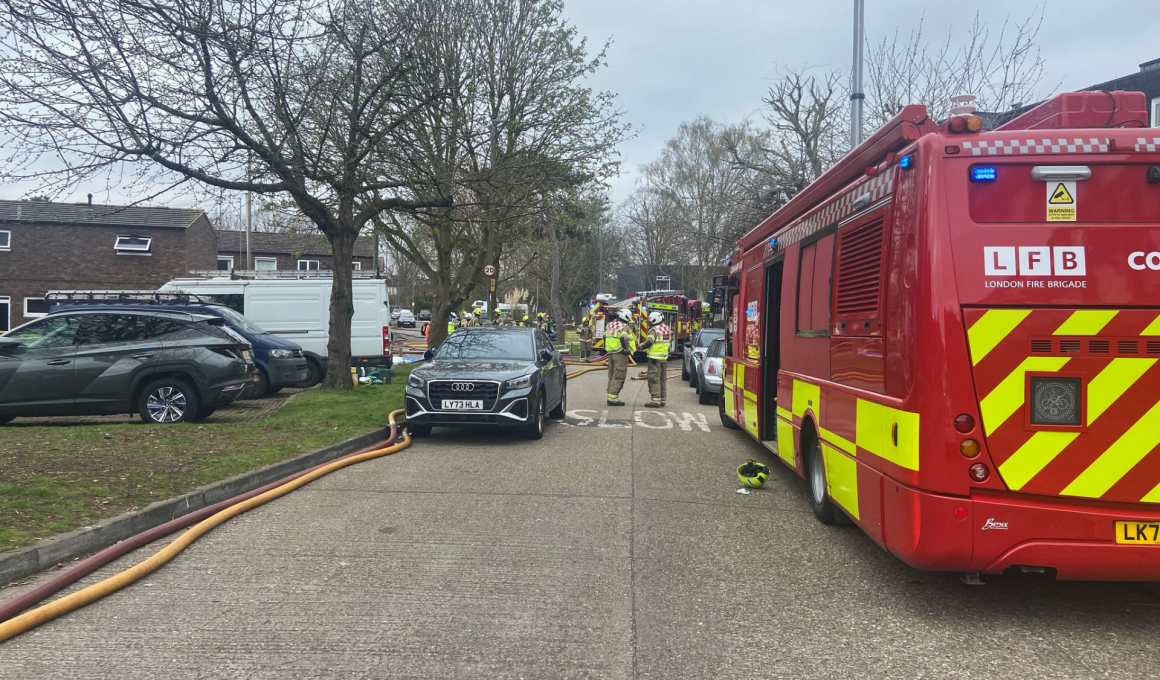
Six fire engines struggled to reach Burke Close that March morning because narrow roads were blocked by parked cars. The 82-year-old resident, who has lived on the Lennox Estate for 41 years, watched firefighters fight just to get access whilst flames ripped through her neighbours’ homes.
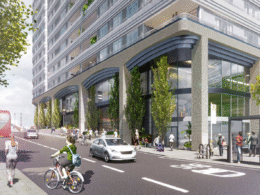
Eight months later, Wandsworth Council has submitted plans for 81 new homes on the same estate. The development would be built on land known as The Green at Arabella Drive – protected open space that residents successfully defended from development in the 1990s. The Fire Safety Strategy makes no mention of the Burke Close fire, despite being completed just 15 days after the incident.
The proposed development would close part of Arabella Drive, provide zero parking spaces for 81 new homes, and create a one-way system that restricts emergency vehicle routes. All changes that would worsen the access problems proven by Burke Close.
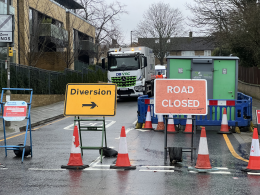
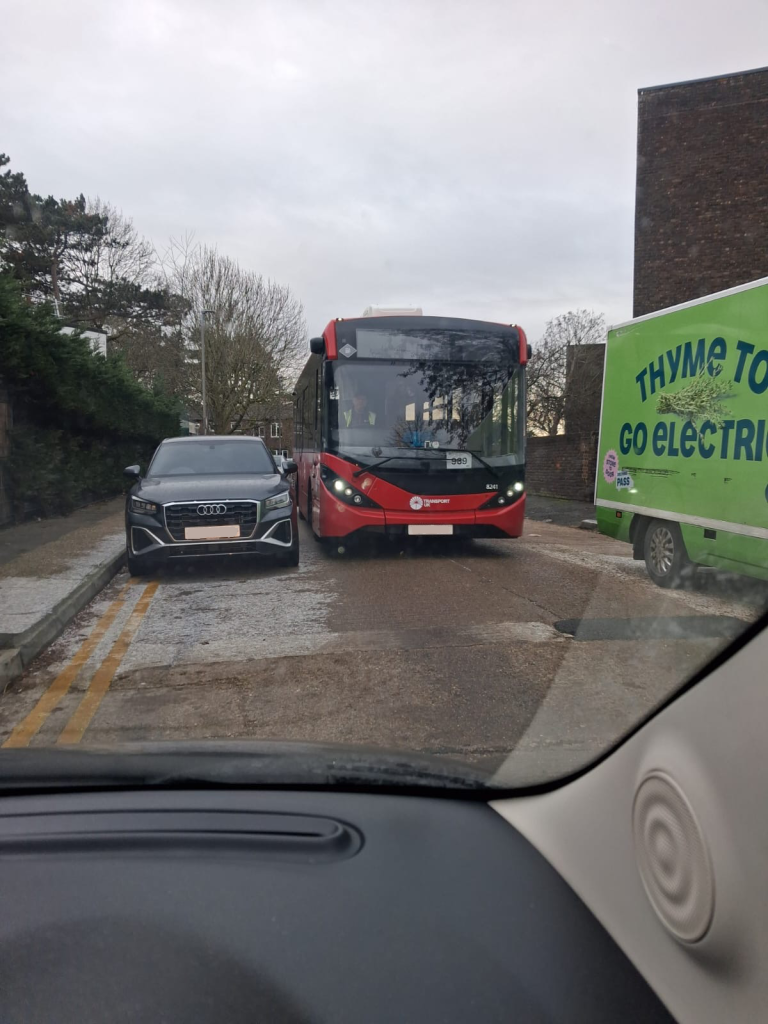
Last month, a local snapped a picture of being stuck on a different part of Arabella Drive because of a bus coming the other way. “I couldn’t get through and they couldn’t either.”
The planning application is open for public comment until 19 January 2026.
Six fire engines, 21 homes, one week without power
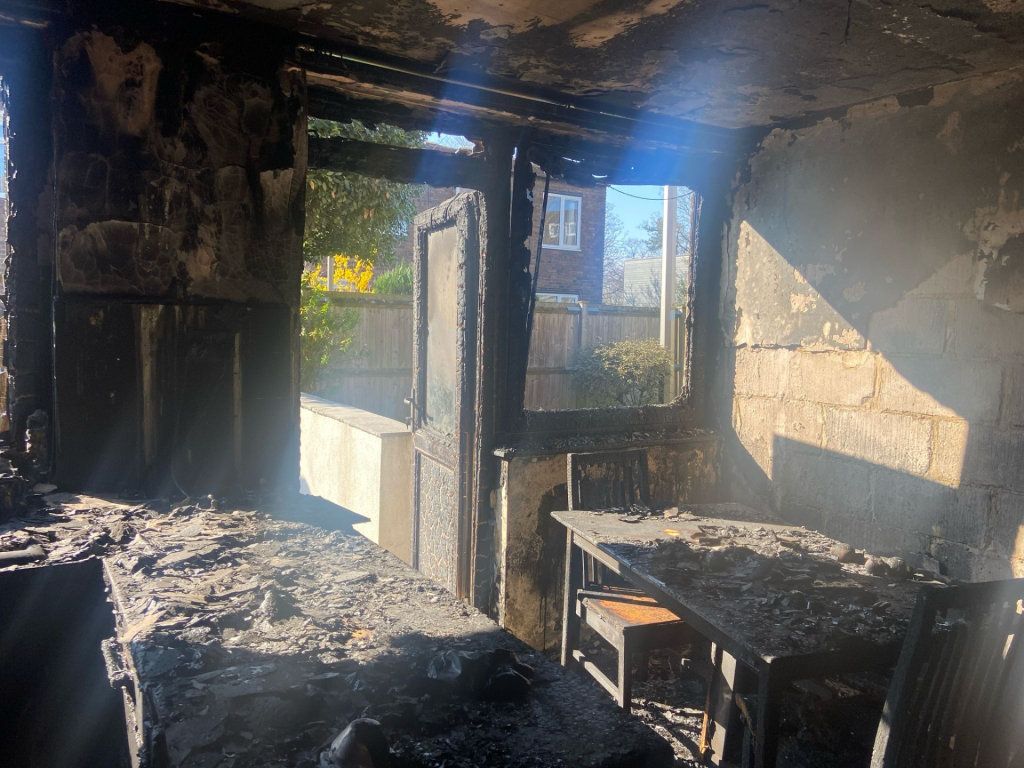
The Burke Close fire on 27 March 2025 was caused when a contractor installing a fence struck a high-voltage electrical cable. The cable ruptured, ignited a gas main, and caused fires at three properties across two terraces.
Council internal logs show “6 x LFB pumps” attended with approximately 40 firefighters. By early afternoon, officials recorded that gas and electricity still couldn’t be isolated and the fire brigade couldn’t confirm the fire was out.
Twenty-one properties lost power. Multiple families needed emergency accommodation. UK Power Networks deployed four teams and estimated power wouldn’t return until 4 April – over a week later.
Bird, chair of the Burke Close Residents Association, told Putney.news at the time that the fire brigade had to fight just to get access through cars blocking the narrow estate roads.
Burke Close is located 800 metres from the proposed development site. Both are on the Lennox Estate in Roehampton.
What the council knew, and when they said it
Internal emails show the council knew the cause of the fire within days but publicly claimed it remained undetermined.
On 28 March 2025, the Area Housing Manager told a councillor the “cause of the fault according to UKPN operatives on site is damage to a cable” by a contractor.
On 7 April 2025, the Interim Executive Director of Housing wrote to a councillor: “In confidence we have had clear advice from them that the fire(s) were caused by the accidental rupture of the electrical main cable.”
But in a letter to residents dated just a few days earlier, the council stated: “The exact cause of the fire is still to be determined.”
The same letter claimed the issues were “not related to council properties” – despite the council being the freeholder of the entire estate, arranging emergency housing for displaced tenants, and coordinating the response with utilities companies.
This pattern of deflecting responsibility featured in our coverage throughout April, as the council praised its own “exemplary” handling of the incident while residents challenged the narrative.
Fifteen days later: a fire safety plan with no mention
On 11 April 2025, fire safety consultants Ashton Fire completed the Fire Safety Strategy [pdf] for the Lennox Estate development. The 31-page document makes no reference to the Burke Close fire, despite addressing emergency vehicle access extensively.
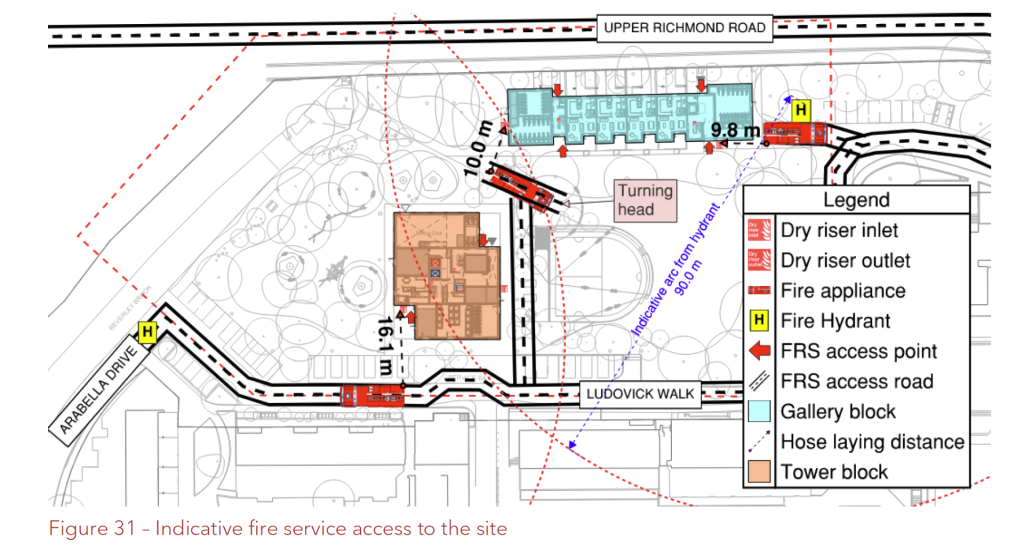
The strategy states that “emergency vehicles will enter the site from Upper Richmond Road, proceeding into Ludovick Walk” and that firefighting operations would rely on the same narrow estate roads where six fire engines had struggled just two weeks earlier.
It contains no assessment of real-world emergency response challenges proven by Burke Close. No evaluation of current parking patterns that block access routes. No analysis of how the proposed road closure would affect emergency response.
The document [pdf] states that “swept path analysis will be carried out by specialists” – using future tense, indicating this critical work had not been completed when the planning application was submitted in November 2025, seven months later. There is no path analysis in the documents provided for approval of the development plan.
Changes that would make access worse
The planning application proposes to permanently close part of Arabella Drive, removing an existing emergency access route. The Planning Statement [pdf] describes this as “a key element” that “unlocks space for new housing.”
All 81 new homes would have zero parking spaces, described as a “car-free development.” Planning documents acknowledge this will displace vehicles onto surrounding streets, but the Fire Safety Strategy contains no analysis of how additional street parking might affect emergency access on roads where six fire engines already struggled.
Ludovick Walk would be converted from a pedestrian route into a one-way vehicle system, becoming the primary emergency access route. The Fire Safety Strategy indicates this would be the main route for fire appliances responding to incidents.
Tony Arthur, a resident who has formally objected to the application, wrote: “What have the emergency services said about the new road plan… the safety issues have not been properly thought of.”
Residents also raise emergency access concerns
Planning objections submitted by residents show they are extremely concerned about emergency access.
Hugo Cerda, who lives at 62 Burke Close – one of the properties affected by the March fire – submitted a formal objection citing infrastructure failures. He wrote: “This area has already experienced a significant infrastructure incident, demonstrating that existing systems are under strain.”
His objection notes that “electrical capacity, broadband reliability, parking provision, and road access are already inadequate” and argues the application should not be approved “until existing infrastructure issues are resolved.”
Tony Arthur, who has submitted multiple objections, repeatedly asked: “What have the emergency services said about the new road plan?” In a later objection, he wrote: “Will the emergency service do a risk assessment of there own as emergency services struggled in the past.”
Julie Maskell objected on road layout grounds, warning that the proposed one-way system “raises serious concerns about safety, access for emergency vehicles, and day-to-day living.” She wrote that if the road is blocked by a van, bus, or emergency vehicle, “residents would be unable to enter or leave. This creates a situation where residents could effectively be trapped within the estate.”
A letter from Ludovick Walk tenants, seen by Putney.news, raises additional emergency access concerns. The residents state that “emergency vehicles couldn’t even access Burke Close because of parked vehicles” during the March fire.
Crucially, they claim that building on The Green would eliminate emergency infrastructure. The letter states: “The Borough Commander criticised the lack of council presence and stated the main Green space of the estate is the collection/muster point for people in the event of such a tragedy. He had no idea of intention to build on the Green.”
The residents also claim “The Green is a designated area for the air ambulance to land for the surrounding area.”
If accurate, these claims would mean the development would eliminate the estate’s designated emergency assembly point and air ambulance landing site – infrastructure that would be needed in the event of another incident like Burke Close.
London Fire Brigade is listed as a statutory consultee on the planning application. As of 5 January 2026, no response from LFB has been received, though the consultation period remains open until 19 January.
Purposefully ignoring information requests
On 14 June – over six months ago – we requested under the Freedom of Information act details about the purchase of replacement boilers for Burke Close.
Under the law, a response was due 11 July. When nothing arrived, we followed up on 12 July. And then again on 12 August. “Please accept our apologies for the delay in responding to you. Unfortunately we are currently still waiting to receive the information that you have requested from the Council’s Housing department,” came back the response. “However, please be assured that we will continue to chase them for this information and will endeavour to issue you with a response as soon as we can. Thank you for your continued patience.”
A month later, on 12 September, we asked for an internal review. It was ignored: “Please be assured that we will continue to chase them for this information and will endeavour to issue you with a response as soon as we can. Thank you for your continued patience,” came back the response.
When we asserted our legal right to an internal review, citing enforcement notices from the Information Commissioner’s Office (ICO) against other London councils, Wandsworth responded: “Please note that the Council cannot carry out an Internal Review of your request before we have responded to your FOI request.”
This statement is categorically false – an internal review can be requested as soon as the legal limit for a response has passed and must be complied with. Our request for information about why the council paid to replace gas boilers when it claimed there was no damage to council-owned properties on Burke Close remains unanswered over three months later.
The Burke Close fire occurred just weeks after Wandsworth Council received a C3 rating – the regulator’s second-worst grade – for housing safety failures. At the time of inspection, the council had 1,800 overdue fire safety actions across its housing stock.
Why fire safety is a planning issue
After the Grenfell Tower fire, the London Plan was updated to require fire safety assessment at the planning stage, not deferred to later Building Regulations approval.
London Plan Policy D12 requires developments to provide “unobstructed space for fire appliances” and “suitable access and firefighting equipment.” London Fire Brigade guidance specifies that access routes must be at least 3.7 metres wide and kept clear of obstructions.
Building Regulations require fire appliance access within 45 metres of all points in a dwelling. For blocks over four storeys – like the proposed 14-storey tower – additional requirements apply.
Fire safety is what planning lawyers call a “material planning consideration.” If a planning committee determines that adequate information about emergency access hasn’t been provided, it can refuse the application or defer it pending additional assessment, including formal London Fire Brigade consultation.
The road closure requires a separate “stopping up order” which must consider emergency services impacts and alternative routes.
The resident who spoke out – then faced eviction
In October 2025, Frances Bird was threatened with eviction. The council threatened to remove her from the home she’d lived in for 41 years over a Facebook comment criticising the council’s Cabinet Member for Housing.
She was pressured to step down as chair of the Burke Close Residents Association despite having just been re-accredited by the council for 2025-27.
The woman who testified about fire brigade access problems during the March fire faced losing her home for speaking out about the council’s housing failures.
What happens next
The planning application reference is 2025/4170. The consultation period runs until 19 January 2026. Residents can view the full application and submit comments via Wandsworth Council’s planning portal.
Because Wandsworth Council is both the applicant (through its housing department) and the decision-maker (through its planning department), this is a “Regulation 3” application requiring heightened transparency.
Residents can request that the application be determined by the planning committee rather than delegated to officers for decision, particularly given the safety concerns raised.
This is the latest development on land that residents successfully defended from housing between 1989 and 1994, when a Planning Inspector ruled the estate was deficient in accessible open space. The same land is now formally listed in Wandsworth’s planning documents as protected open space.
The site is also classified as “medium risk” for unexploded World War II ordnance, with records showing multiple bombs fell on or near the proposed building locations during the Blitz.
Putney.news has requested the London Fire Brigade incident report for the Burke Close fire and asked LFB to confirm whether The Green is designated as an emergency muster point or air ambulance landing site.
Were you affected by the Burke Close fire? Do you have concerns about emergency access on the Lennox Estate? Contact us at news@putney.news.