

The woman the whole thing was for did not want to be filmed.
Magda Harrison’s mother had ordered a kilogram of coffee from her daughter’s roastery in London. Six months later it turned up at her other daughter’s farm, an hour outside Perth, having crossed 25 countries by road and sea without once going near an aeroplane. A camera was produced. She said no.
“She’s very Polish about it,” Magda says. “Not as warm and open about this kind of stuff as I was hoping.”
It took a while. Then she came round, and the thing became what it was always going to be: family and friends standing in a paddock, watching a bag of coffee change hands.
That was day 199. It was also the last day anybody had to say the sentence.
“We’re taking this bag of coffee all the way from London to Australia.”
Edwin Harrison opened almost every video with that line for six months. It is still the first thing on the Curious Roo Instagram account, under 1,263 posts and getting on for eight thousand followers: London to Australia overland. One bag of coffee. One epic journey. World record attempt. Strangers in about twenty-five countries heard some version of it out loud.
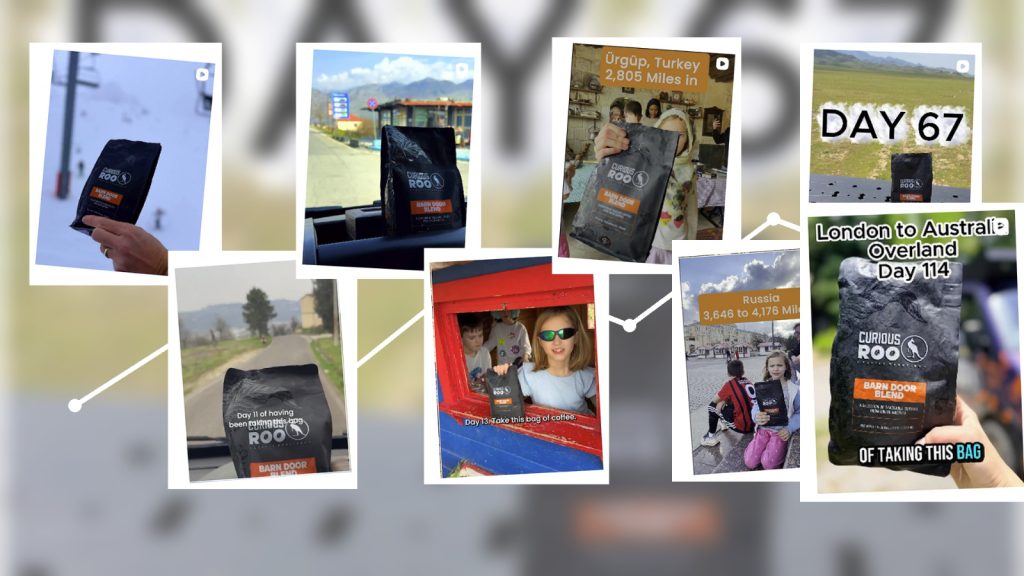
And the bag itself got photographed, over and over, held out at arm’s length in front of whatever happened to be there that day, with the count written on it. A ski lift in the Alps on day 11. Dangling it out a window on day 13. A Turkish shopfront 2,805 miles in. Blank grassland on day 67. Somewhere in Russia between 3,646 and 4,176 miles. Day 114, and still going.
“…and if we make it we’ll set a new world record”
The idea sat in the house for three years before anybody did anything about it. “The hardest part of this whole trip was deciding to go,” Edwin says.
What settled it was a school place. Their eldest was about to move up to secondary, and Edwin had worked out there was a window: old enough to remember any of it, young enough that homeschooling in a van would not be losing a fight with a real curriculum. “I don’t think we would do it when it actually matters,” he says. “When they’re fifteen. It’s almost beyond your skill set.”
Underneath the timing was something less practical. The children were growing up, as Edwin puts it, in “a bit of a southwest London bubble, where it’s all quite comfortable, it’s all quite nice”, and the two of them had decided that was a thing you could act on rather than a thing you noticed.
It was not the first time they had done something like this on a whim. They met in Perth, both studying HR and commerce, Edwin on a master’s. They spent a year in Uganda, Magda systemising a vocational school and Edwin running a beekeeping programme for 300 farmers, came home to London, could not find a decent flat white anywhere near where they lived, and opened one. The first Artisan appeared on Upper Richmond Road in October 2011, Edwin on the till, Magda on the machine. It turns fifteen next month and they still call it their baby.
There are now four more like it, a coffee school that puts more than 1,200 people a year through its courses, and the Curious Roo roastery in Chiswick. Before they left, the Harrisons sat their senior managers down and made them a promise: if anything went badly wrong, one of them would be on the next plane, record or no record.
“Oh, by the way,” Edwin told Magda one evening, “I think I found a van.” Two days later he had bought it. Neither of them had ever slept in one.
So they left East Putney in mid-February with Nile, Danika and Joey, then eleven, eight and six, a converted Mercedes Sprinter named Daisy, and a kilogram of Barn Door blend on the dashboard. There was one rule, and only one: the bag would not get on a plane.
“The bag of coffee’s world record, I suppose,” Edwin said somewhere near the halfway mark. “And we’re just chaperones of the bag of coffee.”
“…overland only, and with our three kids”
Kazakhstan has no campsites and does not need any. You pull off the road and stop. They drove for six days and hardly saw a soul.
The children ran off further than was comfortable and came back talking about a horse that had died years earlier and been left where it fell. Another evening a line of tortoises came out of the desert and the three of them fell in love on the spot.
“I remember thinking, this is so removed from their normal day-to-day in London, where they come home from school and ask to watch the iPad,” Edwin says. “This is my gift to you guys.”
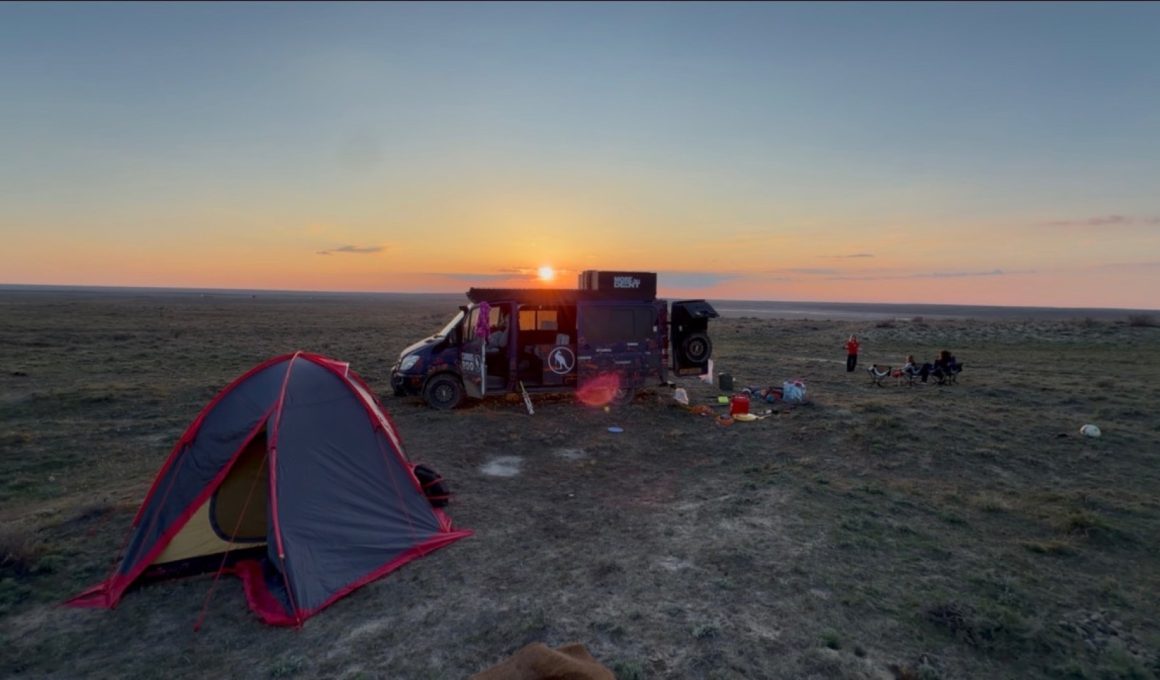
Asked which photograph from 199 days he would keep, he picks one from that week: Daisy parked on open steppe under a pink sky, a tent pitched beside her, one of the girls holding a cricket bat. There are wild horses somewhere out of shot and, he thinks, a camel. “It just shows you’re in the middle of nowhere.”

So what did the kids actually do for six months, much of it inside a van? They read, constantly, which surprised nobody more than their parents. Magda had packed a bucket of toys against the boredom she was sure was coming. “We were being over cautious,” she says. “You only need a ball.”
A ball, it turns out, is the perfect travel companion. Their son doing keepy-uppies outside the van drew people in more reliably than anything the adults tried. In Uzbekistan the family played a football match against their hosts that finished 36-36, which they describe as friendly. Homeschool was maths and English and a journal for a couple of hours a day, until somewhere in Indonesia it quietly became bottle flips, at which point the eldest taught the youngest a life skill and the curriculum never recovered.

And they stopped noticing distance. Getting into the van one morning, Joey asked her father how long they were driving. Five hours, he said.
“Oh,” she replied. “It’s hardly worth getting the Kindle out for.”
None of it was planned, including the thing that made it work. For seven months, nobody in that family was ever more than about five metres from anybody else. Not in the van, not at a border, not in a tent pitched beside it.
The bag sat on the dashboard through all of it.
“As we take this bag of coffee all the way from London to Australia”
The bag on the dashboard was the point of the trip. The rest of the coffee packed into the van was how they met anybody. Magda would set up at the side of a track, grind, and make two cups, one for her and one for Edwin, and then wait.
“Somebody walks past and you just go, ‘do you want a coffee?’,” Edwin says. “The answer is always straight away no. And then you go, no, no, no, have one, and over they come.” Ten minutes later you know their mother’s name. An hour later you have been invited to their house, or warned off a road further along.
It worked in a truckers’ hotel in Turkey, where five drivers climbed down from their cabs and food appeared. It worked on an Italian called Paolo, who took a mouthful and started talking about a revolution. It failed completely in China, the home of tea, where people were too polite to say they did not like it and then said it anyway: too bitter. “I didn’t take it personally,” Edwin says.
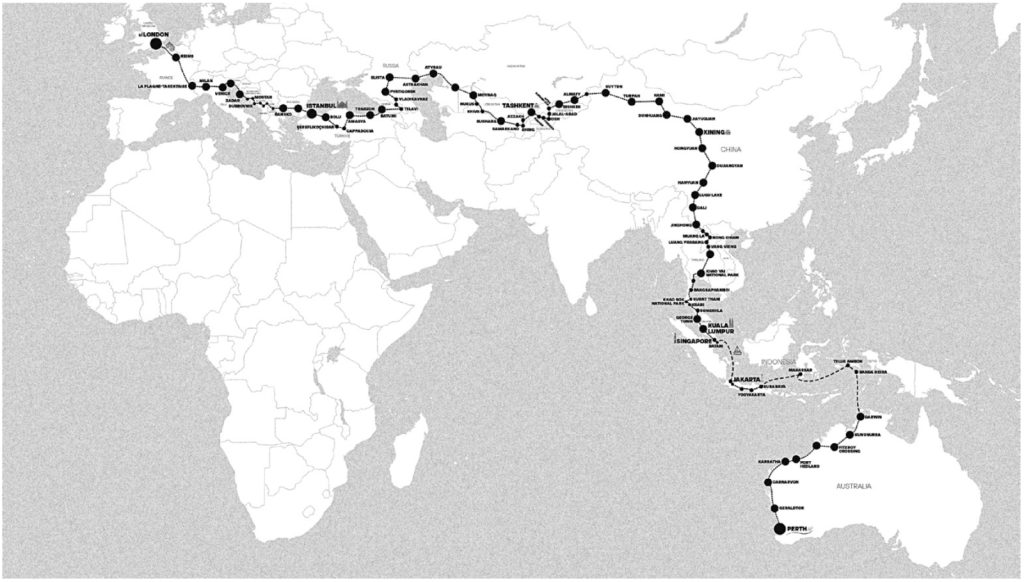
It also worked on people who had never met them. Daisy had the London-to-Australia route painted down her side, which made the family unmissable and, it turned out, contactable. One of the best stops of the trip came from a message that arrived in Java: if you’re driving this bag of coffee all the way from London to Australia, you have to come and visit our farm. They went, stayed three days, and watched Liberica cherries go from tree to cup while their children played cards with the farmer’s children without a word of shared language.
Somewhere in Russia the family got thoroughly lost. No phone worked and no satnav. They went into a coffee shop and said sorry, we know you don’t speak English, we are trying to get here, and a man stood up without much discussion, got into his own car, and led them for twenty minutes until they were on the right road. Then he waved and drove off. They threw a bag of coffee out of the window after him.
Edwin has been turning that over ever since.
“Would that happen in London?” he says. “Would that happen in one of our coffee shops in South West London? And sadly I think the answer’s no.”
A family who went 22,000 kilometres to show their children a wider world came back with a question about the streets they live on.
“…the world record attempt is still on”
Daisy’s heating failed in northern France within days of leaving. She broke down in Croatia because the fuel gauge lied. The Russian border took ninety minutes, two interview rooms and four officials who wanted to know whether Edwin had ever worked for the British government. Tajikistan refused them visas, so they drove round it. Kyrgyzstan offered mountains with no roads on them, and in two days the family covered about fifty miles and slept in a yurt.
Thailand refused Daisy altogether. Border officials looked at photographs of the van, found the sink fitted to filter the children’s drinking water, classified her as a motorhome and declined the permit. The Cambodian border had been shut by conflict since 2025. By now the family had an audience, and it turned out to be useful: a petition took 607 signatures in three days, Andi Peters recorded a video backing it, and Putney’s MP was drawn in. None of it moved Thailand. Daisy crossed the country on a flatbed truck, her wheels never touching Thai soil, while the family followed in a rental car a quarter of her size.

Magda broke her foot on the day they emptied the van in Kuala Lumpur and handed the keys to the couple driving her home. She did Malaysia and most of Indonesia on crutches. There is a photograph of the five of them in front of the Petronas Towers that night, everybody lit purple by the fountains, everybody grinning, and Magda leaning on a hospital crutch. “You have to laugh, right?”


Then there is China. It is the story they tell before any other, and Edwin still tells it as though it happened last week.
Daisy stopped on a remote track. He got underneath her, found the problem, fixed it, and only then registered that he had spent the whole time lying in a red ants’ nest, with the bites to show for it. The van still would not start, because she had also run out of fuel, so he flagged down a motorbike and went to find some. A significant time later he came back, exhausted, fed up and in pain, filled Daisy up, and sat down on the rear tyre with his head in his hands. Where it stank.
“Yeah,” Magda told him. “I let the kids pee on the back tyre.”
“Of all the stories we’re choosing to share,” Edwin says, “that’s the one we share.”
None of it stopped the bag.
“…only twenty-four days to get this bag of coffee all the way to Australia”
Water nearly did.
On a 36-hour ferry into Indonesia, Danika fainted as the ship docked at one in the morning. Her lips went blue, her hands went cold, and for a few minutes her parents had no idea what was happening. Water and a handful of sweets brought her round.
“There was nothing else to eat, it was just rice,” Edwin says. “If you’re ever on a ferry for 37 hours, make sure they eat. You’re so worried about everything else that you forget the basics.”

The next crossing was 86 hours, on a ship where the accommodation was a dormitory shared by about 200 people. Magda went hunting for a crew member willing to negotiate and talked the family into the ship’s medical room, on the understanding that nobody on the entire ship fell ill.
Then, around day 170, the last plan collapsed. A charter from Bali to Broome had been agreed, brochure and all, until the insurer refused to cover it. No ferries ran. Cargo ships had stopped carrying passengers during the pandemic. An earlier arrangement had already fallen through.
“Our world record and trip could end right here,” Edwin said in a video at the time.
So they kept driving east instead, towards the remote Indonesian islands north of Darwin, on the theory that something might turn up if they got close enough to Australia to be worth somebody’s trouble. At Ambon, on day 176, the family split, because Edwin had worked out that crossing the Timor Sea with an eleven-year-old, an eight-year-old and a six-year-old was not a risk he could justify.
What turned up was the far end of a chain of introductions months in the making: a friend called Trent in Perth, who knew Sean in Darwin, who knew a man called Ian, who knew Adam, who happened to be Commodore of Darwin Sailing Club, who knew Tony and Rory, who had a yacht and were sailing back from a race at Banda. Edwin bought a large quantity of beer and got on board.
They shared out an emergency bottle of Jägermeister that had been rolling around the van since February, and then he was gone. “It’s like we’re not gonna see him again,” Magda said.
What followed was ten days at sea in three-hour shifts, three on and three off, day and night, on a boat where every toilet had given up. The crew were “rough around the edges”, Edwin says, drank more than he had ever witnessed, and looked after him completely. He caught his first fish, a yellowfin tuna, was made to eat it raw, and went on making coffee by hand on the cockpit bench with the horizon going up and down behind him. Other overlanders – the name similar adventurers give themselves – stranded in Indonesia never got out at all, because, as Magda puts it, “nobody wants to take that on, the liability of somebody hurting themselves or falling overboard”.

The bag went in a bunk.
Magda and the children flew ahead to Darwin, where Edwin came in off the sea at five in the morning and the Australians, inevitably, had a beer.

Then the drive, which is usually reckoned at five weeks and which they did in five days: thirteen hours at the wheel, then twelve, nine, eleven and ten, eating and brushing teeth on the move.
It was not the record pulling them along. Return flights were booked; any slower and she would have had just two nights with her mother instead of five. “That’s why we smashed that drive,” Magda says.
In the car on the last morning, Magda filmed herself saying it one more time. “Finally coming to deliver the bag of coffee. From the UK to Australia.” Then Edwin spotted the farmhouse.
“See the house! For the rest of our lives we won’t have to say taking this bag of coffee all the way from London to Australia.”
“Yeah,” said Magda. “I hated that.”

So: a paddock an hour outside Perth. Family and friends. A grandmother who had taken some persuading to come out for it. And a kilogram of Barn Door blend, roasted in Chiswick, carried across two continents and an ocean, looking considerably worse than when it set off.
She took it. Nobody had to say the sentence again.
What was waiting
They landed back in London on a Tuesday. The children were at school on the Thursday. “What took us 199 days to achieve on the ground took just 21 hours to undo on an aeroplane,” Edwin says.
Waiting for them was a business that had not needed them.
The standing arrangement, the one where a parent gets on a plane if it all goes wrong, never came close to being used. Nobody rang. Nothing broke that anybody else could not fix.
“We’re not nearly as needed as we thought we were,” Edwin says, cheerfully enough, though it clearly took some getting used to. Magda is more direct about what it did for the people left in charge. Before the trip, she says, “we were petrified walking away even for a weekend.” Now: “It’s proved to them that they can do it.”
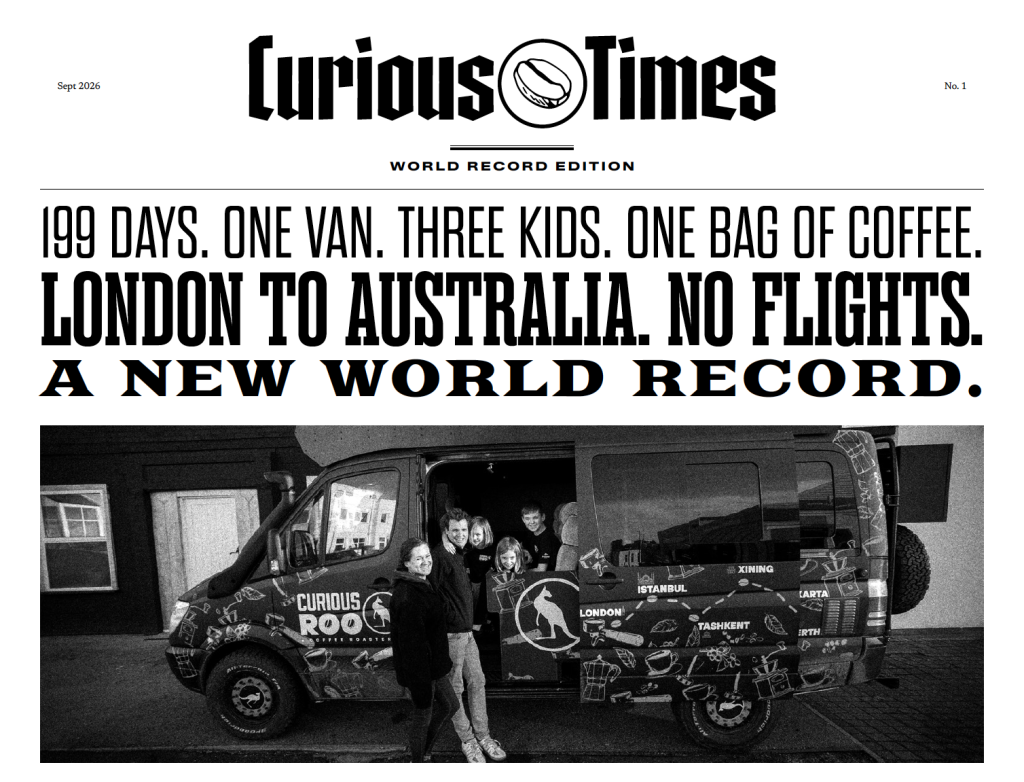
The staff had their own view, and printed it. In a four-page newspaper Curious Roo produced for its wholesale customers when the owners got back, they were asked what the best thing about six months without their bosses had been, one answered “the peace and quiet”. Another: “I finally finished a sentence without being interrupted.” A third: “Nobody started a conversation with ‘I’ve had an idea…'” Told that Edwin was back, one reply ran to two words: “He’s back?”
He had half expected it. Edwin spent the trip sitting down with the best roasters he could find in every country he passed through, and what he came away with was not a technique but the secret formula to success in business.
“It was always people who had a team who had been with them for a long time,” he says, “and somebody who’s incredibly passionate about what they were doing.” That was it. Not the machines, and not the market, which varied wildly: Turkey was still explaining to customers what a flat white is while Laos was barely at the beginning of it. None of that separated a good coffee business from a struggling one.
Edwin has come off production at the roastery altogether, handing it to a colleague, and now spends his time on the part of the business he thinks is too quiet. “Curious Roo’s great, but we’re not known.” Magda is back on the till in Putney most weeks and is honest that the shop does not require it. “Customers like to see the owner.”
One shop did not survive it. Fulham, one of the five, closes this week after two and a half years because it “just didn’t work”, Magda says, which leaves four, a coffee school putting more than 1,200 people a year through its courses, and a roastery they now want to grow. Shops, Edwin says, “are a bit like kids. You don’t want too many.”
Five metres
The children were reabsorbed in about a week. Sport, friends, the same four streets. At the school gate somebody asked Joey what the best part of the trip had been.
“Coming home,” she said.
“I don’t think she meant it,” Magda says, laughing.
What nobody had prepared for was the five metres. For seven months the Harrisons had been within arm’s reach of their children at every hour of every day. Then Nile started secondary school, out of the door at seven and back at six.
“It’s a bit like when you don’t take your phone with you and you’re looking for it constantly,” Edwin says. “That’s been the weirdest adjustment for us. It’s a bit sad in a way.”
Magda is fond and unsparing about them in the same breath. “They’ve pissed us off, you know. But overall we’re surprised how amazing they were.” They are not in awe of what they did, she thinks, and will not be for years. The adults are.
“Never once did we think about turning back,” she says. “Not once. Which is pretty freaking amazing, if you ask me.”
Three years to decide to go. Not one hour, in 199 days, spent thinking about coming back early. Deciding was the hard part. The rest was a series of problems, and the two of them turn out to be very good at problems.
Two things are still going on. When the Harrisons put out a call for somebody to drive Daisy back to London, more than 900 people volunteered and the video was watched 200,000 times. Georgia and Costas got the job and are somewhere in Thailand. The family who spent six months being followed now watch somebody else, from a phone, in Putney.
The other is the record, which is not, in the formal sense, a record. Guinness told them it would count as a commercial record, because the bag carried their own brand and the videos promoted the business, and that certifying it would cost £12,500. They put the money towards More Than a Dent, their own charity, which backs one project a year and which they fundraise for in November.
“We never said the word Guinness,” Magda says. “We’re just calling it our world record.”
And Magda? She is still working out what she brought back. “I need to slow down a bit,” she says. “I’m a bit crazy, the way we all run around in London.” She loves it anyway and says so twice. Edwin’s reading of her is gentler than her own. “You are adjusting. It’s going to take a bit of time.”
Edwin’s summary is not the one he would have given in February. “This trip was meant to teach our children about resilience. In fact, it’s taught us a lot about resilience, while they watch.”
The bubble is exactly where they left it, and their children are back inside it.
Somewhere an hour outside Perth there is a woman who did not want a fuss, drinking her way through a kilogram of Barn Door blend that came the long way round.
“It’d be so nice,” Edwin says, “if this somehow inspired somebody else in Putney to go and do something else they wanted to do.”
Not necessarily 22,000 kilometres. Just that thing they have been putting off.



This story has made my Sunday. It should be come a book. And I live on Wandsworth Common and have never heard of their coffee shops. I will be visiting. What a trip, What a family.
Wonderful story – what an experience to give your children! Bravery and audacity in equal measure!!
Thanks for covering it!