

Do you know where your takeaway is coming from? Not the name of the place you are ordering from through Deliveroo or Uber Eats or Just Eat – but the kitchen itself. You might be surprised.
Wandsworth Council’s register of food businesses lists no less than 37 premises in the borough trading under two or more names, and 18 under three or more. Some of the names belong to restaurants you would queue for. Some belong to the pub down the road. Some belong to nobody you have heard of, and by next week they may belong to nobody at all.
How one kitchen becomes six restaurants
A food business registers with the council once, as a premises. On the delivery apps it can open as many shopfronts as it likes, each with its own name, logo, cuisine tag and menu, each rated and reviewed as if it were a separate restaurant. Nothing on the listing tells you that the Korean chicken and the biryani are coming out of the same fryer.
It is perfectly legal and it is, increasingly, how the delivery trade works, and the people who run the apps know it. Uber’s head of dark kitchens, John Mullenholz, admitted that diners were “effectively seeing 12 versions of the same menu” as companies swamped apps in a bid to be seen. He wasn’t happy about it and argued that the practice “erodes consumer confidence”, but that hasn’t prevented its explosion.
It is most virulent in the hyper-competitive US market but the same issue has come to London in the past year. The number of virtual brands on Uber Eats in North America had quadrupled in two years to 40,000; a New York deli was running 14 of them with the same sandwiches; a San Francisco restaurant had listed its menu 20 times.
Uber removed 5,000 storefronts and wrote rules: a virtual brand must keep a rating of 4.3 or better, its menu must be at least 60 per cent different from its siblings, and an operator may launch only one new name per kitchen every four weeks. Those rules have had an unusual knock-on effect: if you order through a delivery app, you will see new restaurants arrive and disappear constantly, with AI helping to produce new names, images, wording and menus that are created and published in minutes.
Constantly changing
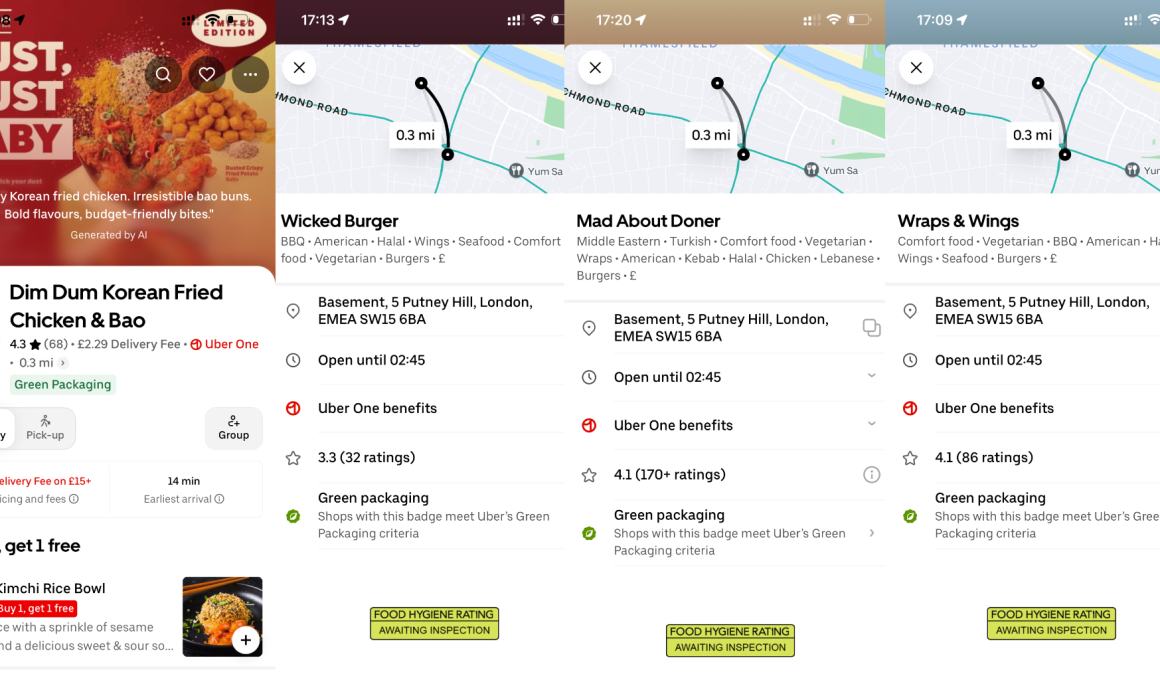
Ultimately, however, you are getting the same food from the same chef, cooked in the same kitchen as you were last week. Goodbye Hakka Chinese, hello Mad About Doner – both of them being cooked in a basement at 5 Putney Hill on the corner of Upper Richmond Road and the High Street.
The motive is simple. Three listings catch more searches than one. A new name gets a “New” badge and a fresh start at five stars. A bad week for one brand does not touch the other two, and a brand that has sunk below the line can be retired and relaunched under another name with its history wiped. Nothing on Saturday evening’s app records that Mamma Mozzarella, rated 1.5, ever existed. In its place at 167 Merton Road in Southfields, opposite the Park Tavern pub, we have Piccante Parlour. And Pachino Pizzeria (rated 3.7), Parlour Pizaloro (3.3), Margarita Pizza (2.8) and Bresola Basil (2.8).
Nor is it one cook per name. The British company that does this at scale, Peckwater Brands, raised £15 million in 2022 with Stonegate, the country’s largest pub group, as lead investor, and now runs its brands from more than 250 Stonegate pub kitchens.
What it sells to a pub or a takeaway is the whole package: name, logo, listing, recipes, packaging, suppliers and staff training. Its chief executive, Sam Martin, has explained the economics in plain terms: a Tex-Mex takeaway “would be well placed to take on a fried chicken virtual brand” because it already has the chicken in stock; “there will also be no need for additional staff; the virtual brand simply uses the idle resource of the original facility”.
Two of Peckwater’s chicken brands, he said, share 95 per cent of their ingredients. One of those kitchens is in Southfields and comes in a very surprising form: a gastro pub.
The Earl Spencer on Merton Road is registered with the council as “Earl Spencer/KT/CB/LL/88th/VM/SC”. Read against Peckwater’s catalogue, that is K-Town, Chik Box, Locked N Loaded, 88th Street Burger, one we cannot place, and Seoul Chikin, Peckwater’s flagship: six chicken and burger brands behind one pub kitchen.
At Putney Hill, Wraps & Wings, Wicked Burger and Mad About Doner all carry the same advert this week, a photograph of seven sauce pots under the word DUNK’D, recoloured for each brand with a different strapline. A fourth kitchen half an hour away, Press & Stack, is running it too.
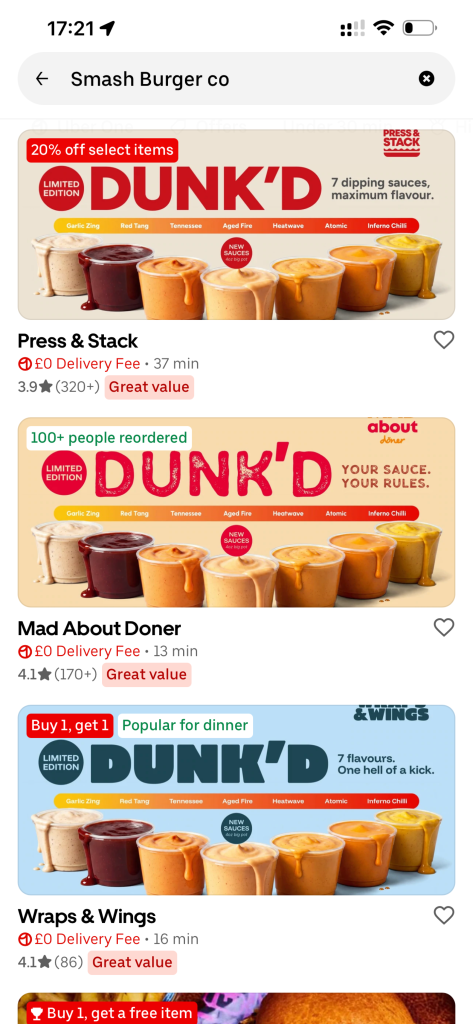
The apps do not say any of this. Uber Eats gives the Putney Hill brands an address, “Basement, 5 Putney Hill”, and leaves the reader to notice it is the same on all four. Until this week Just Eat went one better, at least by accident: its listing for Hakka Chinese gave the restaurant’s address as “Wraps And Wings 5 Putney Hill”, the platform’s own data naming the parent.
That listing is now gone, as are so many of the instant brands that appear, then vanish without trace just weeks later to be replaced with another one.
What this means for you is simple. The star rating you are reading is a rating for a name, not a kitchen. On Saturday evening the basement at Putney Hill scored 3.3 as Wicked Burger and 4.3 as Dim Dum. Same door.
From Dishoom to the basement
Unit 4, 271 Merton Road.
One of the hottest restaurants right now is Dishoom – and for good reason – its Indian food is consistently delicious. London is the home of Dishoom and such is its following that a huge number of people make trips to different parts of the city – and even to its restaurants further afield in Birmingham, Leeds, Manchester and Edinburgh – just to visit them and pick up each restaurant’s unique keyring.
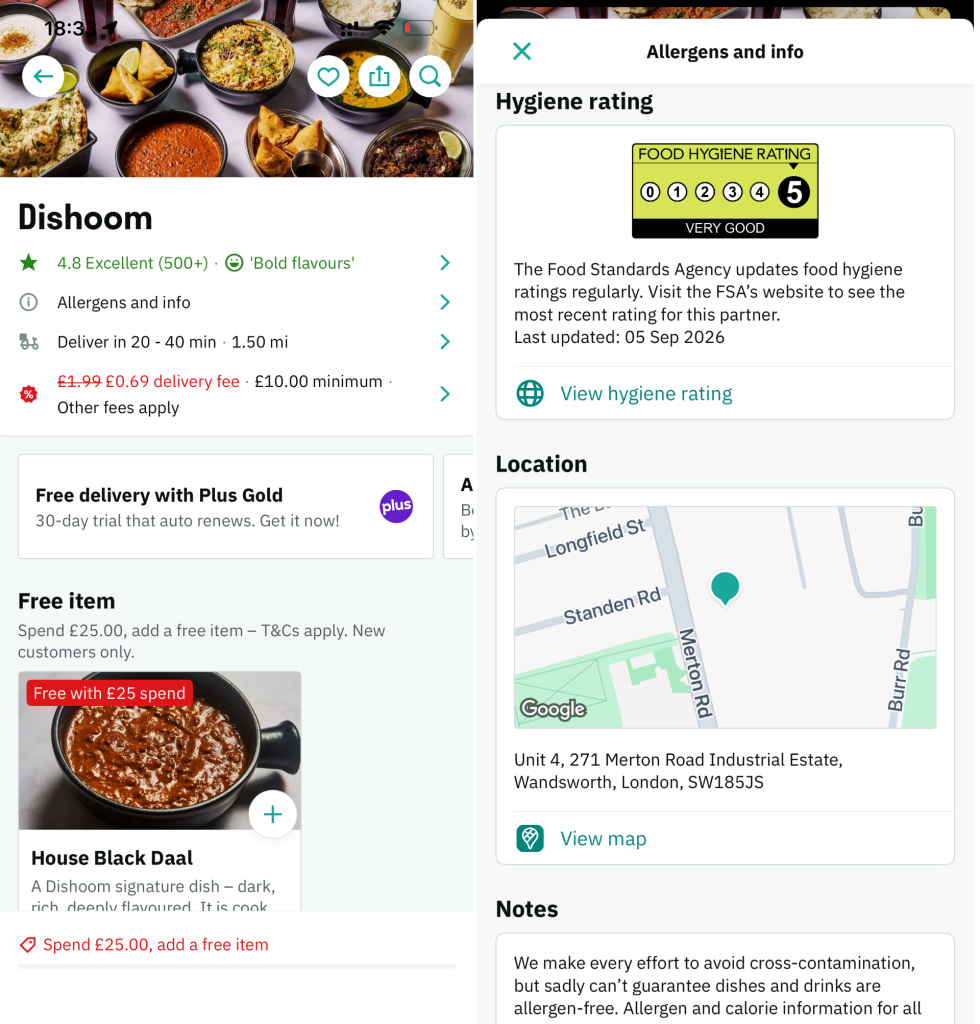
The nearest Dishoom restaurant to Putney is in 20 minutes drive away in Nine Elms but order for delivery and Deliveroo will bring it in within half an hour – a seemingly impossibly fast service. There’s a reason that possible: dig into the details and you will see that it is fact coming from Unit 4, 271 Merton Road Industrial Estate – opposite Coronation Gardens in Southfields.
The blurb promises food “cooked by Dishoom chefs, all served from Bombay with love”. The unit is one of Deliveroo’s Editions sites, a kitchen block it runs for restaurants that want to deliver where they have no branch. The council’s register lists Dishoom, Wingstop, Atis, Pan Asia Box and Cluck and Crusts at the same unit, all rated 5, and “Deliveroo Editions” written into two of the addresses. This is the model done in the open. The platform’s name is on the door.
The Earl Spencer, 260-262 Merton Road.
The Earl Spencer sits about two minutes’ walk from the kitchen block where that Dishoom is cooked, on the other side of Merton Road. It is an Edwardian corner pub, and for years it was one of the best-known kitchens in Southfields: SquareMeal still describes it as “one of the first big successes of the gastropub movement”.
It has changed hands since. It holds a top food hygiene rating and 4.4 stars from more than 640 Google reviews, with regulars praising the staff, the prices and a Sunday roast that comes with bottomless potatoes and Yorkshire puddings. “This is our favourite pub ever,” one reviewer writes. Others miss what it was. “This is no longer a gastro pub,” one told Tripadvisor.
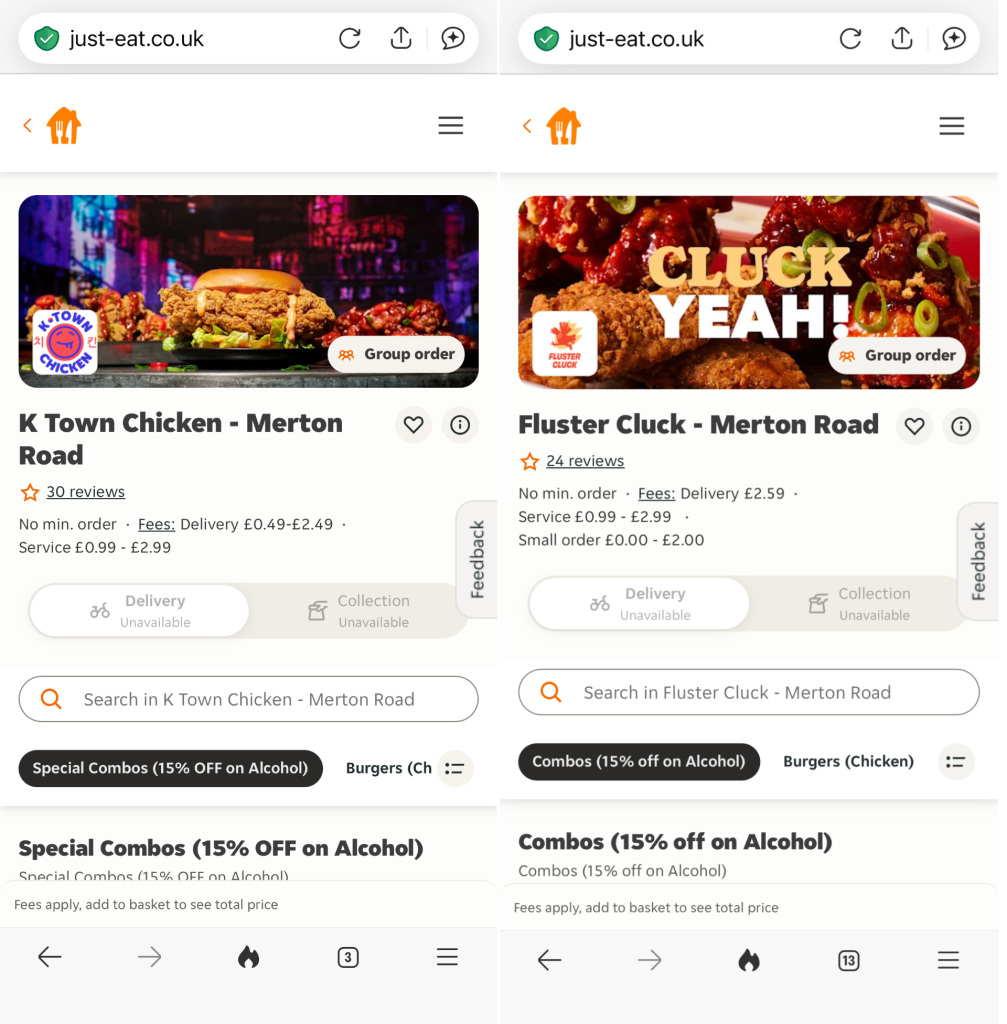
On Just Eat tonight it is also Fluster Cluck, a fried chicken brand with 24 reviews and a menu section headed “Combos (15% off on Alcohol)”. Until last September it was Chik Box on Uber Eats; a takeaway directory lists K Town Chicken at the pub as well.
The council’s register entry for the pub kitchen reads “Earl Spencer/KT/CB/LL/88th/VM/SC”.
Set that against Peckwater’s catalogue and it reads back: K-Town, Chik Box, Locked N Loaded, 88th Street Burger, one we cannot place, and Seoul Chikin, Peckwater’s flagship. The pub has not invented six chicken shops. It has installed them.
The Earl Spencer is a Craft Union pub, and Craft Union is the community-pub arm of Stonegate, the country’s largest pub company, which runs more than 650 of them under agreements with individual operators. Stonegate is also the company that led Peckwater Brands’ £15 million funding round in 2022, and by the end of 2023 it had put Peckwater’s chicken brands into more than 250 of its pubs.
A register entry at a Southfields pub that reads back as a list of Peckwater brands is not, then, a coincidence. The pub sits inside the estate that Peckwater’s own investor supplies.
52 Lower Richmond Road.
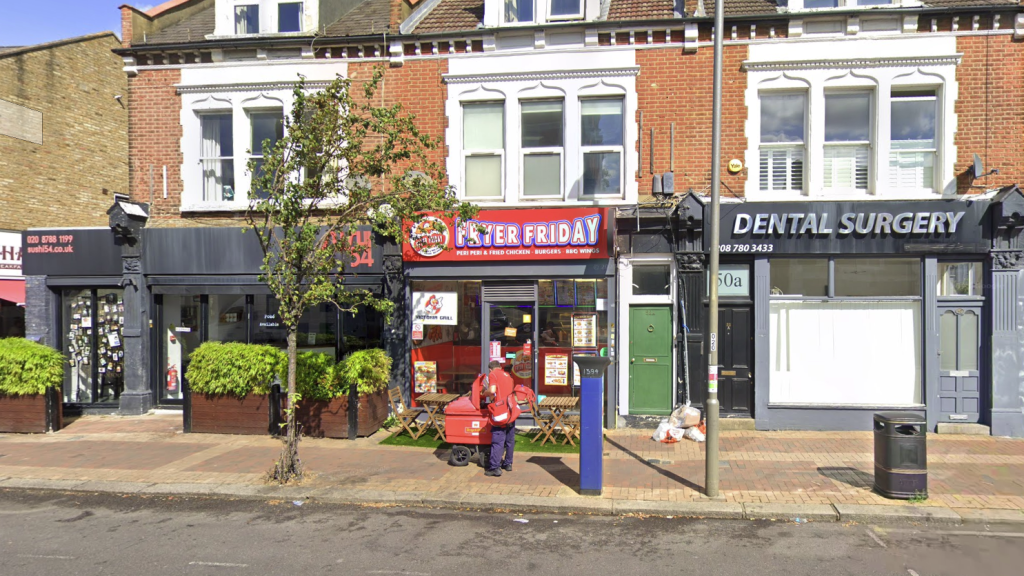
Fryer Friday on Lower Richmond Road was better known for years as Victoria Grill. It did a really good and excellent value chicken, chips and salad served on a wooden chopping board and was a favourite with the local tradesmen. About a year ago, the owners moved on and the place was revamped as Fryer Friday with new screens. The chopping boards have gone but the number of delivery drivers has jumped – and there good reason for that.
The business is registered twice with the council, as Fryer Friday and as Metros Fried Chicken, both with perfect hygiene scores. On Uber Eats it is Fryer Friday; on Deliveroo, Fryer Friday Peri Peri and Fried Chicken; on Just Eat, Fryer Friday Fried Chicken.
Scroll the Uber menu and there, at £7.99, is a “Metros Big Burger Meal”. The second business name – Metros Fried Chicken – is a line item on the first business’s menu.
But while the shop now has two official names, and three brand names for one of those names, the bigger is question is: does this “erode consumer confidence” as Uber’s John Mullenholz says, or is it just a modern version of an old story, just sped up to modern speed?
Victoria Grill became Fryer Friday last year. But before that, in 2021, it was Victoria Grill Peri Peri. In 2014, it was Flavas Peri Peri. In 2012, it was Favourite Chicken & Ribs. In 2008, it was Daisy’s. In 10 years, the same shop had six different names. Now it has six all at the same time.
Basement, 5 Putney Hill.
This is the address that first sparked our interest: we were doing a search of places rated 1 or 2 for Food Hygiene and discovered that the What A Chicken place on Putney Hill had been rated 2 – but under a different name. And that the same address also had a 5 rating – but for yet another completely different business.
We should say, incidentally, that all the other restaurants in this story have perfect 5 hygiene ratings. And while the term “dark kitchen” is often used to describe places that don’t have a traditional frontage or seating or even a place to buy the food, the term has no bearing on the actual state of the place, which are typically professional kitchens. The quality of the food on the other hand is more variable.
At 5 Putney Hill, four brands live on Uber Eats on Saturday evening, all at the same address, all closing at 02:45, all showing the same hygiene badge, “awaiting inspection” – a sign that the council’s food safety visit has resulted in immediate changes and a request for re-inspection.
The council’s register for the building tells a different story: two registrations there carry no less than sixteen trading names between them, covering just about every food type imaginable from Thai to Greek to Nepalese. The building has lettered kitchens; a seafood brand, Lucky Crabs Kitchen, gives its address as “5 Putney Hill, Kitchen B” and has its own phone number. Rio’s Piri Piri, upstairs, is a separate business with its own number and is not part of this.
Three of Monday’s seven brands had gone from the app by Saturday. Hakka Chinese, which had 250 reviews, cannot be found under that name on Uber Eats or Just Eat. The two Maida names have vanished. Nothing on the app records that they were ever there. Next week, there will likely be more.
187 Merton Road.
The largest cluster we found is also the one we can say least about.
Uber Eats’ own data, retrieved this weekend, lists at least seven pizza brands at this Southfields address, sharing two phone numbers, selling the same £18.99 twelve-inch sourdough pizzas under the same emoji-decorated menu heading, every one opening at five in the evening and closing between four and seven in the morning.
Some carry auto-written descriptions for brands that no longer exist: one page introduces “SEVEN GUYS, a burger-focused restaurant” above a pizza menu. On Saturday evening we could find only one of them live in the app.
How to spot one
You do not need a council register to work this out. Three things give it away.
The phone number, where the app shows one. It is the only field that crosses brands. Two restaurants, one number: one restaurant.
The menu. Mad About Doner sells “Crispy Fried Potato Balls”. Dim Dum, at the same address, sells “Dusted Crispy Fried Potato Balls”. Wicked Wings offers “skin-on fries, fried till golden brown”. Same fryer, three menus. When a burger brand and a wings brand describe their chips in the same words, they share a chip pan.
The address. Uber Eats and Deliveroo print it on the listing; tap the information panel. Look for “Basement”, “Unit”, “Kitchen B”, or a number you recognise from another order. And if you want the council’s version, search the food hygiene ratings site by street, not by name. The names will not match.
None of this tells you the food is worse. Like we said, most of the kitchens are rated 5, and the model has produced some of the best-reviewed takeaways in SW15. What it tells you is that the choice on your screen is not the choice you think you are making. The high street of six restaurants is one basement, and the app is not going to mention it.
Tonight the basement on Putney Hill will open at four and trade until a quarter to three under four names. Somewhere between Wandsworth Town and Southfields, a pizza kitchen will open at five under however many names it has this week. And a very good black daal will leave an industrial estate on Merton Road, from Bombay, with love.
Sources: Uber Eats, Deliveroo and Just Eat listings captured by Putney.news on 12 September 2026; Food Standards Agency food hygiene ratings register, queried 7 and 12 September 2026; Uber Eats virtual restaurant guidelines; Peckwater Brands funding and partnership announcements, 2021 to 2023. Operators were not approached for comment: none could be identified from public records before publication.




I don’t eat takeaways as a rule. One bad experience was enough. However, there is obviously huge demand as evidenced by the growing army of delivery drivers on mopeds with L plates.
I just checked 5 Putney Hill on Google Maps. It’s the home of Rio’s Peri Peri, a takeaway restaurant that I believe has been there for a year or two. It has a website which displays its hygiene rating: 2, meaning “requires improvement”. If they are cooking for all these online brands then surely these brands should be displaying the same hygiene rating?
A 2 rating would be enough to put me off any of them!
Extraordinary research, I appreciate all the time and energy you have put into this article.
I’ve read this article twice – and I don’t really get the point you’re trying to get across here?
Businesses rebrand all the time, and remove/launch constantly (it also comes across a little bit rich to call out use AI and imply it being used for this might not be good – when this very site clearly uses AI tools extensively).
Equally, dark kitchens have been around for many many years – both in dedicated premises as well in other takeaway shops. There are entire businesses which match takeaways with brands to act as their dark kitchen.
As a consumer, I can choose to order from an unknown brand, or a more well-known one.
This is no different to any other kind of online shopping…?
Fair question, and the straight answer is that we thought it was worth knowing about. As the piece says, none of this is illegal and none of it is new. But it has grown quickly enough that the platforms themselves are uneasy: Uber’s own head of dark kitchens said diners were effectively seeing twelve versions of the same menu and that it erodes consumer confidence, and Uber pulled around 5,000 storefronts in North America off the back of it.
The specific worry is what ratings are for. A star rating is about the only public scrutiny a takeaway faces, and a brand that sinks below the line can be retired and relaunched under a new name with the history wiped. The app then shows you that name with a “New” badge, which reads as a fresh arrival rather than as the same kitchen starting again with a clean sheet. That is the bit that makes it different from ordinary online shopping: you can choose a known brand over an unknown one, but nothing on the app tells you that the new food option is the old one wearing a different hat. The speed and ease of that turnaround is surprising and may become a problem.
Anyway, we found it interesting, and we all know a bit more than we did.