

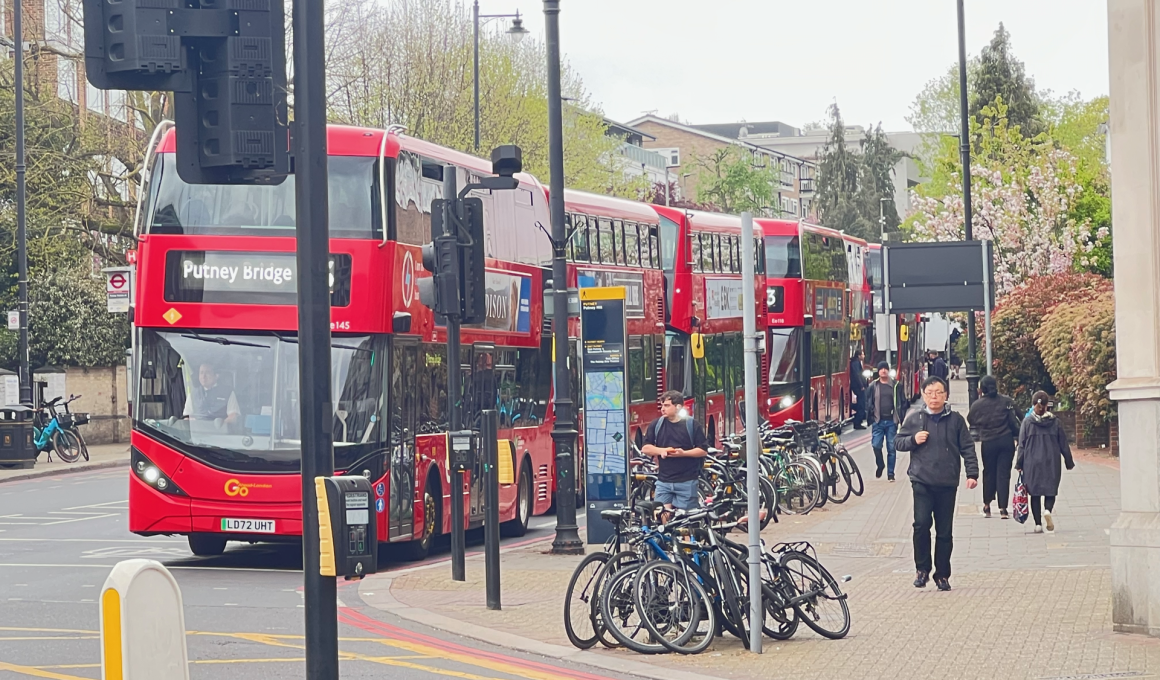
Putney’s buses run more or less as promised for about four weeks a year. It is the stretch from late July to the middle of August, when the schools break up and the roads empty out.
Then term starts, and they stop managing it.
Every London bus route is contracted to run at least 98 per cent of the miles on its timetable. Across fourteen routes serving Putney and Roehampton, that has been managed in 28 four-week periods out of 364 since April 2024. About one in thirteen. On the 39, the 170 and the 270 it has not been managed once, in any period, in either year.
The bus that passed and failed at the same time
The 85 is not a bad route, on paper. It runs from Putney Bridge station to Kingston, and it is judged against two standards written into the same contract.
The first is waiting time: how much longer you stand there than the timetable says. The 85’s limit is one minute. In the year to March it came in under that in ten periods out of thirteen.
The second is mileage. It managed that once in thirteen. Same route, same year, same contract, opposite verdicts. How is that possible? Here’s how:
Waiting time is measured at fixed points along the route. A bus that turns round early never reaches the later ones, so the wait it caused never gets counted. The miles it did not drive still do.
Through the spring, passengers were being turned off the 22 in Fulham and off the 85 and the 93 at the Green Man, and told to wait for the next one. On the first measure those journeys barely register. On the second, they are the whole story.
There is a version of this on television. In 1981, satirical comedy Yes Minister sent Jim Hacker to St Edward’s, a gleaming new hospital in north London with 512 staff on the books, not one patient, and an award nomination in the post. Having patients around, one of the officials explains, would be no help at all.
The 85 is Putney’s St Edward’s. It scores well for the journeys it did not finish.

Two scores, one bus
Route 85, Putney Bridge to Kingston, 2025/26. Each square is one four-week period. Filled squares are the periods the route met the standard written into its contract.
Waiting time
10/13
Average excess wait 0.85 minutes against a standard of 1.00
Miles actually run
1/13
96.1% of scheduled miles operated against a standard of 98%
| Period | Excess wait (mins, standard 1.00) | Mileage operated (%, standard 98.00) |
|---|
Source: Transport for London route performance report, route 85. A bus that turns back early does not reach the point where waiting time is measured. The miles it did not run are still counted.
The seasonal pattern is interesting because it holds in both years we looked at and on both measures. In the periods covering the Easter, summer and Christmas breaks, the thirteen main Putney and Roehampton routes averaged 1.06 minutes of excess wait in the first year and 0.92 in the second. In the other ten periods they averaged 1.32 and 1.21.
On mileage the same split runs 95.5 and 97.2 per cent in the holidays against 93.9 and 95.1 in term. The best single four-week period in two years ran from 20 July to 16 August last summer.
Putney’s buses work best when the schools are shut
Average excess waiting time across 13 Putney and Roehampton routes, by four-week period. Lower is better. Shaded periods contain the main school holidays.
| Period | 2024/25 | 2025/26 |
|---|
Source: Transport for London route performance reports, 13 routes serving Putney and Roehampton. Periods run in four-week blocks from 1 April. Figures are unweighted means of route values.
Same roads. Same drivers. Same buses. Take the traffic away and the service works.
That is now the fourth time the same thing has shown up. Night buses on these streets perform among the best in the borough. The 485, which touches Putney along the river and never goes down the High Street or over the bridge, met its mileage standard in half of the 26 periods, when nothing else in the group managed more than five.
The 424, which comes down from the Green Man through Putney Hill, the High Street and over the bridge, has missed its 78 per cent punctuality standard in every period for two years, best 77.00, worst 52.21. And now the calendar says it too.
Why this is the “before”
Wandsworth has spent two years altering the Putney Bridge junction, and the bus stops are a large part of it. The stop outside Kenilworth Court on Lower Richmond Road was suspended in November 2025 (since rescinded). The carriageway opposite TK Maxx was widened from 26 January, because buses stopping there leave nothing for anything else to get past. A review of that stop and of driver changeovers was due in March.
The change with the biggest expected effect has not happened. A proper pull-in bay outside TK Maxx needed utility works, a phone box gone and signal equipment moved. The phone box only came out in July. Work is going on as we speak.

So every figure above is the before. There is now a complete two-year record of how Putney’s buses performed while the junction was rebuilt around them, which makes it possible to say whether any of it worked. The answer: slightly but not enough.
The figures for April to June go before three councillors on Monday evening: Cllr Noel Dube, who chairs the group, Cllr Nick Austin and Cllr Jenny Yates. Two of the three represent Putney and Roehampton wards.
The paper in front of them gives each route’s waiting time, and the same figure a year earlier. It does not give the standard the route is contracted to meet, and it has no mileage column at all.
Put the standards back in and four of the thirteen main Putney and Roehampton routes are outside their contract on that page: the 14, the 22, the 170 and the 265. The 424 is on 60.5 per cent against a standard of 78. The councillors are asked to receive and note it.
At the last meeting, in March, the group was told that Putney’s main bus routes had all improved on the same quarter a year before. On the figures that paper provided, that was true. With the figures not provided, it wasn’t.
And of course there are the actual passengers – the patients at the fictional St Edward’s TV hospital – that don’t exist, on paper at least.
The same passenger liaison group asked TfL in May last year for figures on how often buses turn back early, and for a note explaining what the waiting-time measure does and does not capture. Sixteen months and two meetings later, neither has arrived. Neither is on Monday’s agenda.
What the junction work has changed so far
Share of scheduled miles actually operated, averaged across 14 Putney and Roehampton routes. The contract requires 98 per cent. It has not been reached once.
| Period | 2024/25 | 2025/26 |
|---|
- Nov 2025Bus stop P, outside Kenilworth Court on Lower Richmond Road, suspended
- 26 Jan 2026Carriageway widened opposite TK Maxx, three weeks of works
- Mar 2026Review of the TK Maxx stop and driver changeover arrangements due
Still to come. The pull-in bay outside TK Maxx, the change with the largest expected effect, has not been built. The phone box blocking it was removed in July 2026. Everything on this chart is the before.
Sources: Transport for London route performance reports; Wandsworth Council letter to residents, 22 January 2026. TfL’s published route data currently ends in March 2026.



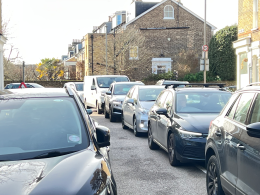
A really shocking finding here (lol!): that the buses run much more on time in the school holidays when many people are away. Now why on earth could that be? It can’t be – surely! – that the buses, and all the people in them, are held up by too many cars – most of them with one person sitting in them!
But no, we have to fiddle around at the absolute margins with the junction nonsense whilst missing out the real solution, which is to reduce the number of cars (preferably by the use of dynamic road pricing) dominating the roads. But no, that will be construed as that idiotic meme, “the war on the motorist.”
The increased size and popularity of “Sports Utility Vehicles” often in evidence (presumably on the schools drop off) must also be a factor.
For those of us old enough to remember the DAF and Bedford transit vans, the latest version SUV’s are approximately 10″ wider and just under 34″ greater in length.
I would suggest these ridiculous vehicles are inappropriate on London streets in general, their contribution to the overall problem is self evident.
While increased car traffic certainly contributes to bus delays, focusing solely on private vehicles misses several critical non-traffic factors that speed up bus journeys during school holidays:
Shorter Dwell Times: Subdued commuter spikes result in fewer passenger bottlenecks at stops, allowing buses to spend significantly less time idling while people board.
Optimized Timetable Frequencies: TfL frequently scales back service frequencies and suspends dedicated school routes during breaks. Counterintuitively, running fewer buses reduces bus-on-bus corridor congestion and prevents “bunching” (where multiple buses on the same route clump together).
Eased Operational Friction: Systemic variables like driver scheduling gaps, dispatch delays, and signal timings are far less prone to cascading disruptions when overall network demand drops.
In what I suspect is a vain attempt to shift the focus away from car traffic and on to other forms of transport which could help with freeing up road space and improving air quality, I am sharing a link to an article on the beneficial impact that electric bikes and scooters could make in Putney – if there was a will to do it from the Council and all of us individually. Am braced for the backlash! https://theconversation.com/the-worlds-280-million-electric-bikes-and-mopeds-are-cutting-demand-for-oil-far-more-than-electric-cars-213870