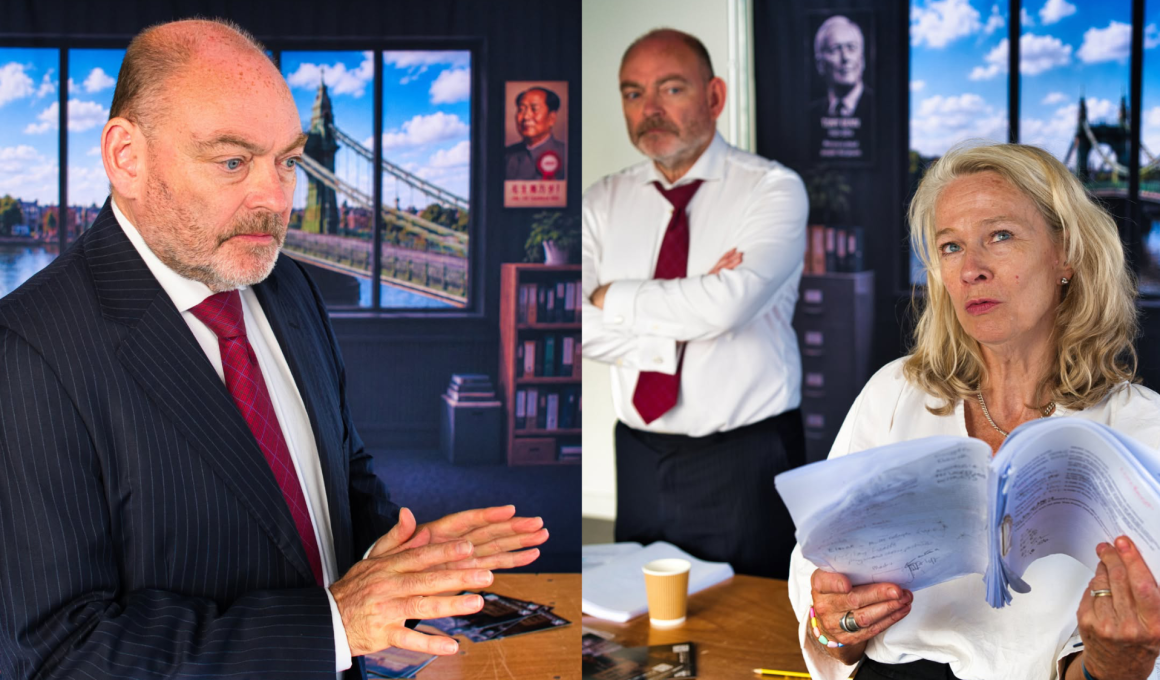
Hammersmith Bridge is Falling Down opens on an argument between an MP and his hard-edged political adviser revealing a dynamic more like an unhappily married couple that work colleagues. Add a new junior assistant with no patience for party mechanics, who just wants to know why nobody can simply fix a bridge, and you understand why this Sunday matinee at OSO Barnes holds its packed, cosy room. It isn’t really about the state of Hammersmith Bridge. It’s about the three people arguing over it. Solid writing, a relevatory scene forty minutes in, and a cast better than the tiny stage lets them be. It just needs a bit more nerve to be genuinely excellent rather than merely very good.
The play is set entirely in the office of Edward Stiles (Daniel Wain), a Labour MP with one stalled mission: get Hammersmith Bridge reopened. The national debt won’t allow it, and the party won’t back him beyond its stock advice – blame the Tories – which he’s finding harder to stomach given his own six years of promising a Labour government would fix it. Stiles is directed here by Lucy Appleby at OSO, a theatre built inside what used to be Barnes’s old sorting office (OSO).
The poster outside makes the equation explicit: “a new play about a broken bridge”, with “bridge” struck through and “Britain” written in above it. It’s a blunt joke but works: Stiles can’t move the bridge because the debt won’t allow it and the party won’t let him say so, and he can’t move his own life for much the same reason, still relitigating a six-year-old promise and a conference speech he’s never topped since. Violet (Louise Bangay) as his long-standing advisor is the institution too exhausted to keep fighting and too stuck in the past to rejuvenate; Lavinia (Nicole Cuthbert) is the reasonable outsider asking why any of this should be so hard.
The play’s cleverest piece of writing comes later, in a live interview where Stiles tries to prove, on camera, that he can finally be honest. Coached beforehand by Lavinia, he reaches for a line that sounds right and delivers it with real conviction, the kind of plain speaking a career politician isn’t supposed to be capable of. But it was borrowed, without Stiles realising it, and his world comes crashing down. It’s a sharp, quiet joke about a party so busy fighting over its own history that it can no longer tell which century its best arguments are coming from.
The many faces of honesty
Bangay’s Violet is coiled tight through every scene and gets the biggest laugh of the afternoon needling her boss him over a sudden, unconvincing health kick. Cuthbert’s Lavinia is loose and confident where Violet is wound tight, leaning on desks like she owns them. She pushes Stiles toward honesty and gets more of it than she bargains for. “You see! This is why politicians can’t be honest!,” Stiles despairs when he hits a moment of revelation. The script flirts with sending the two of them somewhere more predictable, and then pointedly doesn’t; Stiles’s anger at the suggestion is one of the more grown-up choices in the writing.
Vaughan Evans, playing Welsh party colleague Dafydd Thomas, does the useful double job of mate and machine, delivering the party’s stock line with the weary conviction of a man who’s said it many times before. He’s one of a small chorus of Westminster colleagues (Stephen Riddle plays three of them) drifting through Stiles’s office in a run of regional accents, revealing the machinery and machinations beneath it all.
The best scene belongs to Wain. Stiles relives, in full, the party conference speech that was the peak of a career that never went anywhere else. He steps out of the office and into the memory, catches himself halfway back in the present but turns again to accept congratulations nobody is actually offering, before slipping back into his current, unpromising reality. It’s a lovely piece of stagecraft and watching it, you understand exactly how far this man is from wherever he thought he was going.
The one thing standing between this and a five-star review is the room. OSO’s stage is tiny, and at the moments where the writing wants real fury, the actors visibly have nowhere to put it; the production plays safe rather than risk anyone going over the edge of it. There’s also, for reasons known only to the props department, Stiles pouring his whisky from a clear plastic water bottle, a small thing that shouldn’t matter and somehow does, each time he reaches for it.
This isn’t a play for a light Sunday out; there’s no dancing, not much joy – although there are quite a few good laugh lines – and if you have zero interest in why British politics seizes up the way it does, it won’t convert you. But if that question does interest you, Barnes has put on a thoughtful, well-performed answer to it, worth catching before it closes on Friday.
Solid writing, two properly good scenes, a rousing ending and a cast better than the room quite lets them be: four stars, with a genuine five within reach if this cast trust themselves off the leash. It opens on an argument between three people that never lets up. All it needs now is the nerve to let that argument get loud.
Hammersmith Bridge is Falling Down, by Brad Sutherland, directed by Lucy Appleby OSO Arts Centre, Old Sorting Office, 49 Station Road, Barnes until Friday 11 September, 3:30pm & 7:30pm daily Tickets £19–£21 · osoarts.org.uk / 020 8876 9885 Running time approx. 2hrs, including a 20-minute interval. Step-free access, wheelchair ramp.
Cast: Daniel Wain (Edward Stiles), Louise Bangay (Violet Roberts), Nicole Cuthbert (Lavinia Howard), Vaughan Evans (Dafydd Thomas), Stephen Riddle (Tom Fraser, Derek Lorimer & Jack Lynch)